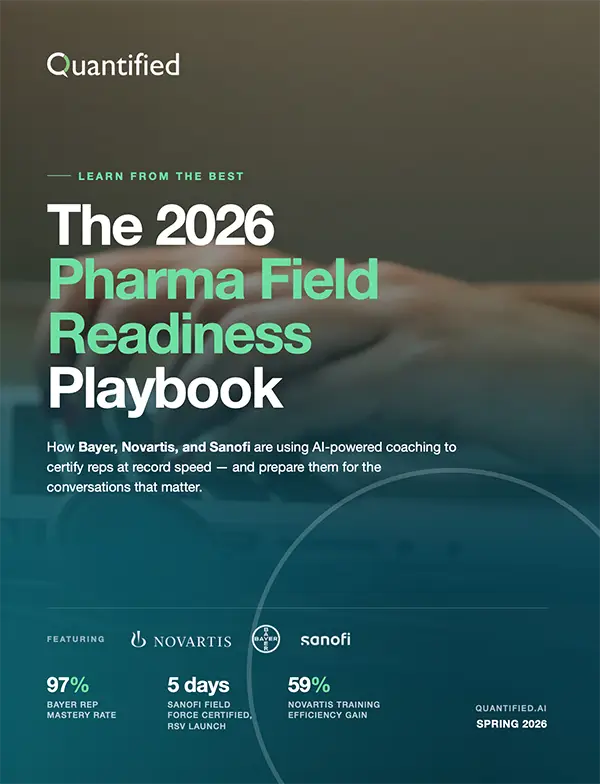
The 2026 Pharma Field Readiness Playbook
Download Now




AI roleplay is a simulated sales conversation: a rep practices with an AI buyer and gets instant feedback. AI sales coaching is the system around it, deciding what each rep practices next, scoring behavior against a standard, and reinforcing skills until they show up in the field. They are not rivals: roleplay is the core practice capability inside coaching.
The distinction matters because the market has collapsed it. Dozens of vendors now sell AI roleplay, from generic B2B practice bots to full enablement suites, and buyers use the two terms interchangeably. The confusion has a cost. In a Gartner survey of 227 chief sales officers, 31% cited difficulty proving the ROI of AI-driven tools as a top challenge for 2026. Buying a standalone practice tool when you needed a coaching system is one of the fastest ways to end up in that 31%.
Here is the test that separates the two:
AI roleplay drops a rep into a realistic, unscripted conversation with an AI-simulated buyer. In life sciences, that means a lifelike, low-latency HCP persona tuned to the product, the prescriber, and the rep: it raises specialty-level clinical objections, questions efficacy data, and pushes back the way a physician actually does. The rep speaks, the persona responds, and the session ends with feedback on what worked and what did not.
Done well, roleplay reliably produces two things: practice volume and confidence. Reps rehearse without waiting on a manager's calendar and without performing in front of peers, so they practice more, and they walk into real calls having already heard the hard objection. That is why AI roleplay is now standard equipment in serious commercial training programs, and why nearly every vendor in the category leads with it.
What a practice conversation cannot do, on its own, is decide what the rep should work on next, whether the team is ready for launch, or whether the practice transferred to the field. That is no knock on roleplay. It is the reason the best roleplay deserves a coaching system around it.
AI sales coaching wraps a decision system around practice. Instead of offering a scenario library and hoping reps choose well, a coaching platform:
Quantified is the AI sales coaching and roleplay platform built for life sciences: the most realistic AI roleplay on the market sits at the center of an adaptive coaching engine that personalizes practice for every rep and certifies readiness on evidence rather than attendance. We have described the destination as a classroom of one: every rep working on exactly what they need next. For a full breakdown of the category, start with what AI sales coaching is.
Side by side, the difference is scope. One simulates a conversation. The other runs a readiness system, with those conversations as its practice engine.
Three reasons, and all of them are specific to regulated selling.
First, HCP conversations are too scarce to waste. Veeva Pulse data shows field teams share supporting content in fewer than half of HCP interactions, and nearly 80% of approved content is rarely or never used. The industry's problem is not a shortage of assets; it is execution in the conversation. When access is limited, the metric that matters is whether each rep is ready for the few conversations they get.
Second, in pharma, practice itself carries compliance weight. Reps rehearsing claims, efficacy language, and objection responses need guardrails grounded in approved content, on-label scoring, and audit-ready records of what was practiced and how it was scored. That is compliance governance, and it is a coaching-platform function; a standalone practice bot was not built for MLR scrutiny. It is also why generic tools stall inside pharmaceutical commercial organizations.
Third, the ROI question is coming either way. Gartner expects sales organizations with AI-driven enablement to reach 40% faster sales stage velocity than traditional approaches by 2029, and the same research argues the gains come from changing seller behavior inside the workflow, not from adding tools. Behavior change is only measurable if you are scoring it, which is the difference between reporting sessions completed and reporting coaching effectiveness.
For most regulated commercial teams, the honest answer is both. Roleplay without coaching produces practice you cannot prove; coaching without roleplay has nothing to coach from.
Five questions expose the difference faster than any demo script: What decides what a rep practices next? Can you score against our approved messaging and show the record? What does ready mean on this platform, and how is it proven? What happens between practice sessions? And what evidence connects usage to field outcomes?
This is where the both-and framing stops being a slogan and starts being a workflow. The realism is the point: the more lifelike the sparring partner, the more signal the coaching layer has to work with. Coaching is what turns a hyper-realistic avatar into a coach in your pocket.
During onboarding, new hires practice from day one while the platform adapts difficulty to each rep. At launch, practice becomes certification: when FDA approval came early, Bayer Oncology certified 90% of its roughly 300-rep field in seven days because every rep could practice and be scored in parallel. And in the field, pre-call preparation and post-call debriefs keep skills from decaying between training events.
The pattern across customers is consistent: teams practice six times more than with traditional roleplay, reach readiness 40% faster, and deliver 19% more good selling outcomes. For how four pharma L&D leaders took this from pilot to scale at Bayer, Regeneron, Sanofi, and UCB, read From Pilot to Practice. For the wider evaluation, our complete guide to AI sales training for life sciences covers the category in detail.
No. AI roleplay is the practice conversation; AI sales coaching is the system that decides what to practice, scores it against a standard, and reinforces it until field behavior changes. You need both, and on a true coaching platform you get both: roleplay comes included as the practice engine. Very few roleplay tools include coaching.
Most vendors in the category do: Quantified (built for life sciences and regulated industries), Second Nature, Hyperbound, PitchMonster, and SmartWinnr, plus enablement suites such as Mindtickle and Allego that have added roleplay features. The real differences are in scoring depth, personalization, and compliance governance, not in whether a conversation happens.
No. Certification requires a defined readiness standard, objective scoring against approved messaging, and an auditable record of who met the bar. A practice tool can generate conversations; it cannot prove readiness.
It solves a different problem. Managers bring judgment and context; AI coaching brings practice volume, consistency, and objective scoring that no manager team can deliver at scale. Tenured reps are often the most skeptical, and often converted once the personas hold up to specialty-level clinical questioning. The strongest programs are hybrid: AI handles repetition and measurement, and managers coach what the data surfaces.
Track readiness rather than activity: proficiency scores, message adherence, time to readiness, and certification pass rates, then correlate them with field outcomes such as call quality and quota attainment. If a platform can only report logins and sessions completed, it is a practice tool with a dashboard.
The fastest way to understand the difference is to experience it. Book a demo, run a roleplay against a lifelike HCP persona, then look at what sits behind it: the scoring, the adaptive next assignment, and the readiness view leadership will actually use.