How To Plan Your First AI Roleplay Pilot
Download Now



The real call has a nurse practitioner who asks the question the physician was about to ask. It has a detail aid on the screen and an HCP who wants to know what the second chart means. It has a rep who knows every word of the approved message and still looks down at their notes instead of at the person across the desk.
Most practice is simpler than that: one rep, one persona, and a script the rep knows well. That practice builds message recall, and recall matters. My view is that the distance between a certified rep and a confident one opens up in the moments simple practice leaves out. The second stakeholder, the visual aid, the delivery, and feedback that fits the situation all belong in practice, not just in the field.
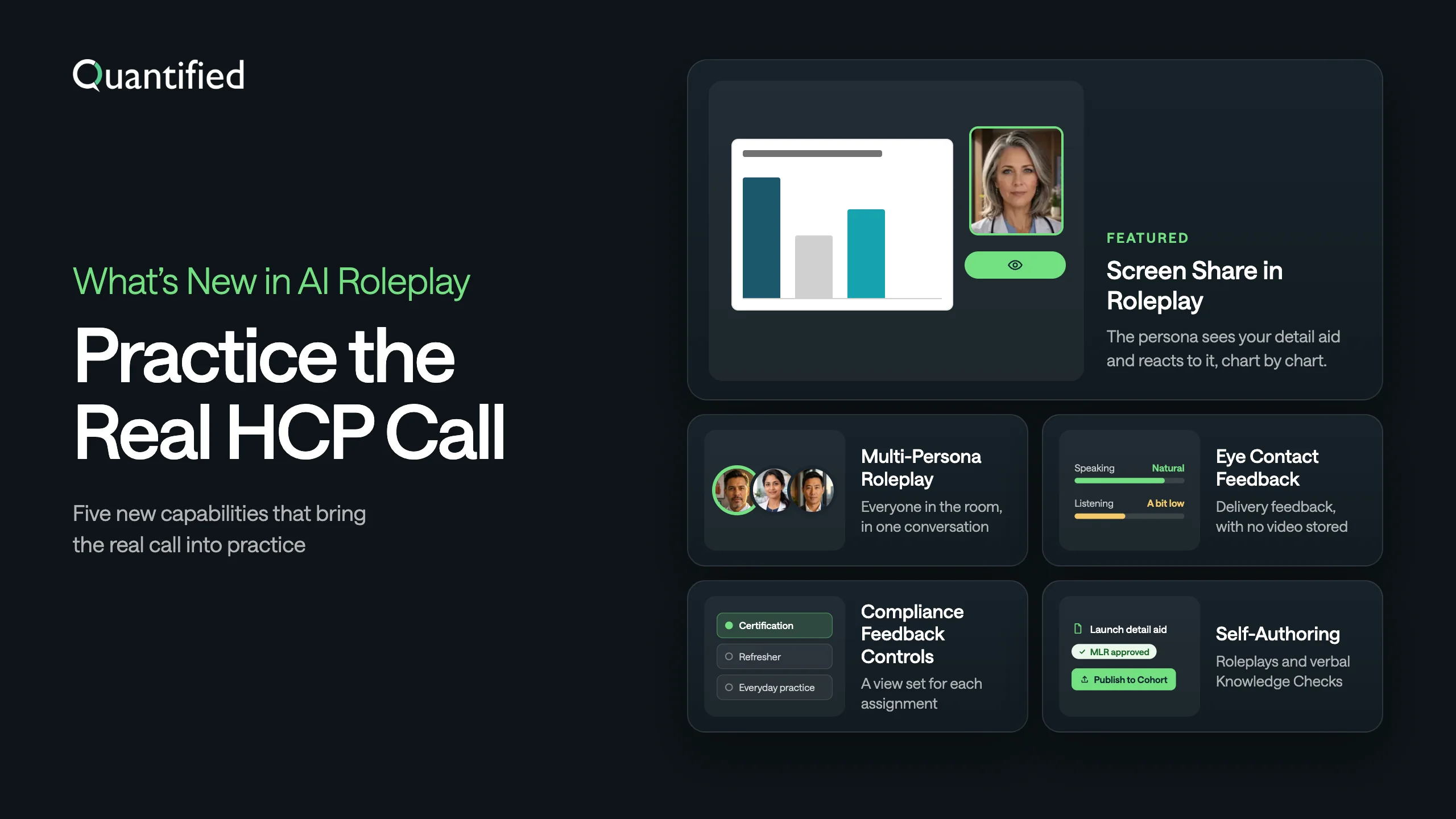
That is the thinking behind what we released on November 19, 2026. Five new AI Roleplay capabilities are now available: Multi-Persona Roleplay, Screen Share in Roleplay, Eye Contact Feedback, Compliance Feedback Controls, and Self-Authoring for AI Roleplay and verbal Knowledge Checks. Each one brings a piece of the real call into practice.
Our CEO, Noah Zandan, put the problem plainly: “Reps don’t fail in the field because they didn’t know the message. They fail when the conversation gets hard. This is practice for that moment.”
Reps can hold one practice conversation with several AI personas at once, each with its own role, priorities, and objections. The personas react to each other and hand questions to the right person, so a rep can rehearse with a physician and a nurse practitioner together, or with clinical and pharmacy stakeholders who want different things from the same meeting. Managing the room is a skill, and it is hard to practice anywhere but live.
Reps can share approved visual aids and presentations during practice. The persona sees what is on screen and reacts to it, chart by chart. Reps rehearse how they walk an HCP through clinical information with the materials they will use in the field, not just what they say about it.
Reps get feedback on how consistently they held eye contact while speaking and while listening, with a short tip on what to adjust. It is measured on the device, no image or video is stored, and each organization decides where it is turned on. That answers the first questions reps and compliance teams will ask, and it keeps practice a space reps trust.
Training and compliance teams choose how compliance results appear to reps, from three compliance views, and set the view for each assignment. A certification, a compliance refresher, and everyday practice can each present feedback in the way that fits, so your organization follows its own policies while every rep still gets feedback they can use.
Commercial training teams can create and update AI Roleplay scenarios and verbal knowledge assessments from their own approved content, tailoring personas, messaging, and scoring criteria as the business changes. When the label changes or a new indication lands, practice changes with it. Reps show they know the information in a Knowledge Check, then apply it in a realistic HCP conversation.
In a regulated commercial team, compliance has to shape practice from the start. Everything in this release runs on the same foundation as the rest of AI Roleplay. Practice is built from your approved content and scored against your own criteria, so the score reflects your definition of good. Off-label language is flagged, and every session leaves a record your compliance team can review: the transcript, the scores against your criteria, and a timestamp.
That foundation also changes what training leaders can see. Roseann Kovelman, Director at Bayer Oncology, described it this way:
“Leveraging AI in our certification process allows us to be more targeted in our training initiatives. We know exactly what and where the knowledge and skill gaps are, allowing us to tailor training initiatives where the team needs it most. Our learners also get immediate and detailed feedback, better equipping them to own their development.”
Self-Authoring gives training teams direct control, and some teams want exactly that. Others want a partner. You can choose either path:
White-glove service is included in every AI Roleplay program either way. It is not a paid add-on.
AI Roleplay is where most teams start with Quantified. It connects to Readiness AI, which personalizes learning for each rep and assesses readiness by proficiency, and Field AI, which helps reps prepare for and debrief HCP visits and gives managers the signals to coach. The new capabilities matter most where the stakes are highest, in product launch readiness and certification programs.
If any answer is “no” or “too long,” that is the gap between your practice and the real call.
No. Eye contact is measured on the device, no image or video is stored, and each organization decides where the feature is turned on.
Scenarios are built in days from content you have already approved, whether your trainers author them or our team does.
Off-label language is flagged, and every session produces a record your compliance team can review: the transcript, the scores against your criteria, and a timestamp.
The fastest way to understand these capabilities is to watch a session. Explore AI Roleplay, or See a Demo and we’ll walk you through a live session.