The 2026 Pharma Field Readiness Playbook
Download Now




Will AI replace the pharma sales rep? I can say with confidence, it will not. What it is doing is automating the work around the rep: targeting, next best action, call prep, and content assembly. What it leaves untouched is the live conversation with a skeptical, time pressed physician. As that conversation gets rarer and shorter, the question shifts from how many reps you field to how ready each one is.
The headlines say the rep is finished. A wave of agentic AI is moving into pharma commercial teams, and the louder predictions write off the field force entirely. The reality on the ground is more specific. AI is taking over the preparation and decision support that used to surround a sales call, not the call itself.
Look at what shipped in the past year. Analysts describe agentic AI reshaping the launch playbook, with targeting, sequencing, and content generation handed to software at speed. The same shift now reaches both sides of the call. Quantified's AI Field Coach preps a rep for the specific HCP conversation ahead, then runs a structured debrief against approved messaging afterward, coaching that used to depend on catching a manager between territories.
None of that steps into the exam room. A model can tell a rep which oncologist to see on Tuesday and which data to lead with. It cannot read the room when that oncologist cuts the meeting to ninety seconds and challenges the safety profile. That part still belongs to a person, which is why the sharper question is not whether AI replaces reps, but what it now demands of them.
It helps to separate the stack into two layers. The first is everything that happens before and after a call: who to see, what to say, when to follow up, and which content to bring. This layer is filling up with agents fast, from next best action engines to omnichannel orchestration to automated content assembly.
The second layer is the call itself: the ten or ninety seconds where a rep has to open well, handle an objection on label, and earn the next meeting. No agent performs this for the rep. The stack can load the rep with perfect inputs and still watch the interaction fail if the human cannot execute.
This is the gap most commercial teams have not named yet. They are buying intelligence for the first layer while assuming the second takes care of itself. It does not. Knowing the right message and delivering it under pressure are different skills, which is why traditional role play falls short.
What AI now automates (the inputs)What still depends on the rep (the execution)Choosing which HCPs to see and whenOpening a constrained meeting well in the first secondsRecommending the next best action and channelHandling a safety or access objection on labelAssembling and personalizing approved contentReading a skeptical physician and adjusting liveSummarizing prior calls and scheduling follow upEarning the next meeting inside a shorter visit
Access math is the reason this matters more every quarter. Veeva Pulse finds that about 45% of HCPs are now accessible to biopharma, down from roughly 60% eighteen months earlier, and half of the physicians who do engage meet with three or fewer companies. In the most restrictive specialties, a large share will see only one.
Fewer doors, shorter visits, higher stakes. When a rep gets one constrained meeting instead of four relaxed ones, the quality of that single interaction carries the territory. A model that optimizes targeting raises the odds of getting in the door. What happens after the door opens is still a human performance, and it is the variable with the most leverage and the least automation.
That reframes field force effectiveness. Coverage and call volume still count, but in an access constrained market they explain less of the result than they used to. Execution quality, the thing the AI stack does not touch, explains more.
If the commercial stack now decides who to call and what to say, the missing piece is whether the rep can actually do it. Call that the readiness layer. It is not another targeting agent and it is not a content system. It is the practice, certification, and in the moment coaching that turns approved messaging into a confident, compliant conversation.
This is where Quantified sits. Quantified is the AI sales coaching platform built for life sciences and other regulated industries, with AI Roleplay and the AI Readiness Coach running on one Adaptive AI engine that scores more than 1,400 behavioral dimensions in a single conversation. The point is not to add another dashboard to the stack. It is to make the rep ready for the moment every other tool is working to set up.
In a regulated setting, readiness has to be earned inside the guardrails. Practice that drifts off label, or that leaves no record, creates risk rather than removing it. Effective readiness work for pharmaceutical commercial teams stays anchored to approved messaging, supports OPDP adherence, and produces audit ready records of what was practiced and how it scored, so message adherence is something leaders can see and stand behind.
It also answers the question pharma buyers keep asking: where does this fit? A readiness platform does not compete with your LMS, CRM, or next best action engine. It is the execution layer on top of them, integrating with Veeva and Salesforce and turning their outputs into rehearsed rep behavior.
Readiness is not a one time onboarding event, and it is not only for new hires. That is the most common misread: that AI coaching is a training wheel for first year reps. Experienced reps face new indications, new safety data, and harder access objections every launch cycle, and they are the ones whose single meeting carries the most revenue.
The teams treating readiness as a continuous discipline are seeing it in the numbers. Across more than 30 enterprise customers, including 10 of the world's largest pharmaceutical companies, Quantified reports a 6x increase in rep practice, a 40% reduction in time to readiness, and a 19% increase in good selling outcomes. The pattern holds in named programs: Bayer trained 500 reps in record time, Sanofi certified its full team ahead of a launch, and Novartis built simulation into onboarding at scale.
Readiness also extends past the launch window. Continuous coaching and reinforcement keeps the highest value behaviors sharp between calls, with pre-call prep and post-call debriefs through the AI Field Coach, so a rep walks into the constrained meeting having already rehearsed it. When AI handles the inputs and the rep is genuinely ready for the conversation, the two layers compound. Gartner has found that sellers who partner effectively with AI are 3.7x more likely to hit quota, and in pharma that partnership only pays off if the human half is prepared.
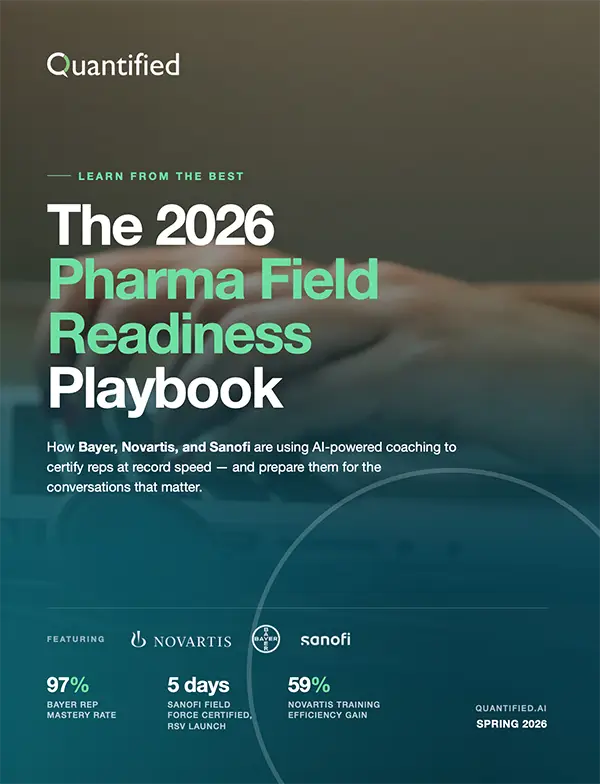
The pharma commercial stack is getting an AI brain. It still needs a ready rep to close the loop. The companies that win the next few years will not be the ones with the most agents. They will be the ones whose reps are most prepared for the few conversations that decide a brand. See how leading life sciences teams build that readiness in the 2026 Pharma Field Readiness Playbook, or request a demo to see the platform in action.
Not in the foreseeable future. AI is automating the work around the rep, such as targeting, next best action, call prep, and content, while the live HCP conversation stays human. The effect is to raise the bar on rep readiness, not to remove the role.
Agentic tools handle preparation and decision support: choosing which HCPs to see, recommending the next best action, assembling compliant content, and summarizing prior interactions. Quantified's AI Field Coach, for example, preps reps before a specific HCP conversation and debriefs them against approved messaging afterward, so every call in the cycle gets coached, not just the ones a manager can ride along on.
The conversation. A rep still has to open a short meeting well, handle objections on label, read a skeptical physician, and earn the next visit. As HCP access shrinks, that single interaction carries more weight, which makes execution quality the highest leverage variable left.
No. Onboarding is the most common entry point, but experienced reps face new indications, fresh safety data, and tougher access objections every cycle. Continuous readiness work keeps senior reps sharp for the high stakes meetings where the most revenue is at stake.
It is the execution layer on top of them. A readiness platform does not replace your LMS, CRM, or next best action engine. It integrates with Veeva and Salesforce and turns their outputs into rehearsed, on label rep behavior, with audit ready records.