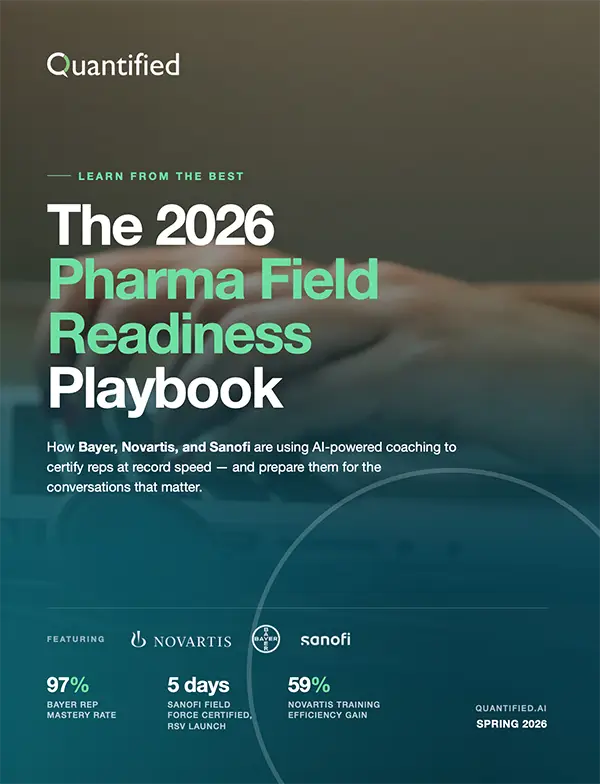
The 2026 Pharma Field Readiness Playbook
Download Now



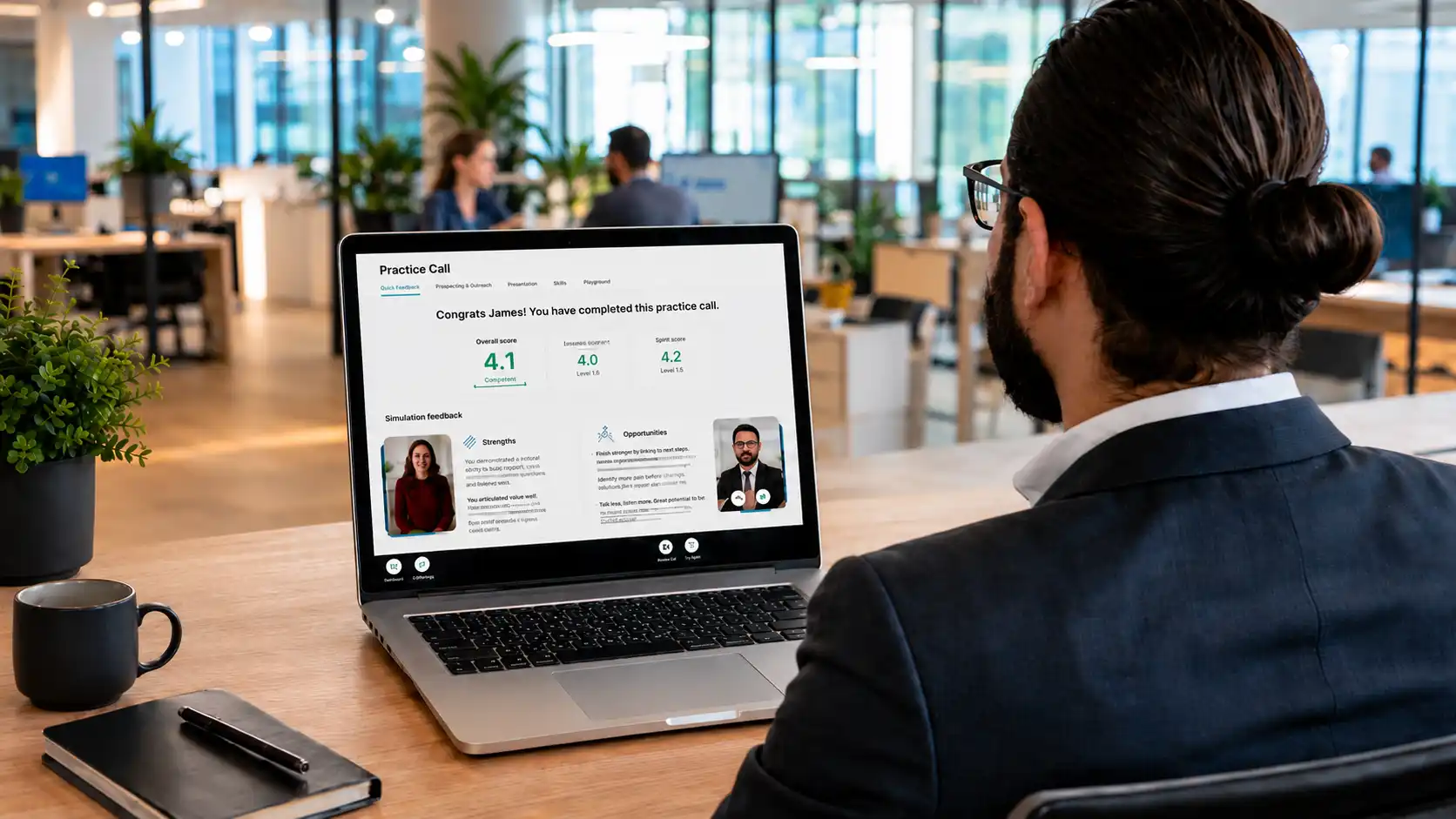

AI sales coaching is the use of artificial intelligence to help sales reps practice, get feedback, and improve continuously across their full lifecycle, rather than in a single training event. For pharma commercial teams, it combines realistic roleplay, readiness scoring, compliance-aware practice against approved messaging, personalized feedback, and manager visibility into one continuous coaching system, so reps are ready before they reach the healthcare provider (HCP).
The move from training as an event to coaching as a continuous system is one of the most important changes in commercial readiness in years. This guide defines AI sales coaching, shows the research behind why it works, explains how it operates inside a platform, and lays out what to look for if you sell in a regulated industry where every conversation carries weight.
Three numbers frame the stakes. The average B2B seller now spends only 40% of their time selling, according to Salesforce's 2026 State of Sales report. Sellers who effectively partner with AI are 3.7 times more likely to hit quota, per Gartner. And in life sciences, only 45% of healthcare providers are now accessible to reps, down from 60% eighteen months earlier (Veeva Pulse, 2024). Fewer conversations, higher stakes, and a technology that rewards the teams that use it well. That is the environment AI sales coaching is built for.
40% of a seller's time is spent selling (Salesforce, 2026) | 3.7x more likely to hit quota when sellers partner well with AI (Gartner) | 45% of HCPs are still accessible to reps, down from 60% (Veeva, 2024) |
AI sales coaching applies artificial intelligence to the work a great sales manager does: putting reps in realistic practice situations, observing how they perform, giving specific feedback, and reinforcing the right behaviors until they hold. The difference is scale and consistency. A manager can coach a handful of reps a few times a quarter. AI can coach every rep, on demand, scoring each interaction against the same standard.
It helps to separate three terms that often get used interchangeably: sales training, sales coaching, and sales enablement. The difference between training and coaching is not academic. Training transfers knowledge: product facts, a methodology, a compliance rule. Coaching builds and verifies behavior: can the rep handle the objection, deliver the message on label, and read the room. Sales enablement is a third thing again, the content and tools that support selling. AI sales coaching sits squarely in the behavior-change category. It exists because knowing is not doing, and real behavior change requires more than reading a script.
The reason this matters: most organizations measure training completion and assume readiness follows. It does not. Completion tells you a rep finished a module. It says nothing about whether they can perform when a physician pushes back. Training completion is a poor proxy for readiness, and AI sales coaching is the mechanism that closes the gap between the two.
The case for coaching over one-time training is well supported. It rests on some of the most replicated findings in learning science.
Memory of new material decays fast without reinforcement. The forgetting curve, first documented by Hermann Ebbinghaus in 1885 and successfully replicated in 2015, shows that recall of freshly learned material drops sharply within days and keeps falling without active review. A single training event, however good, is fighting human memory and losing.
What reverses the decay is not more studying. It is retrieval and practice. In a landmark study published in Science, Karpicke and Roediger found that students who repeatedly practiced retrieving information recalled about 80% of it a week later, versus 33 to 36% for those who studied the same material without practicing recall (Science, 2008). The act of performing, not consuming, is what makes learning stick.
Active practice also beats passive instruction on outcomes. A meta-analysis of 225 studies in PNAS found that students in traditional lecture formats were 1.5 times more likely to fail than those learning through active methods (Freeman et al., PNAS, 2014). Translated to a commercial team: reps who practice, roleplay, and get tested outperform reps who watch and listen.
And the quality of practice matters as much as the volume. Anders Ericsson, who originated the research on expert performance, found that what separates elite performers is deliberate practice, defined as sustained focus on tasks just beyond current ability, paired with immediate, expert feedback (Harvard Business Review, 2007). Generic roleplay with no feedback loop does not build mastery. Targeted, repeated, feedback-rich practice does.
This is exactly where traditional sales roleplay falls short. It is infrequent, it depends on a manager's availability and mood, the feedback is subjective, and reps rarely get enough reps to reach proficiency. AI sales coaching reduces those limits.
Skepticism is healthy here, so look at the data in two parts: the proven value of coaching itself, and the emerging impact of AI applied to it.
Coaching, done well, moves revenue. CSO Insights found that teams with a dynamic coaching approach, where coaching is consistent and tied to the sales process, achieved a 55.2% win rate, 19% above the study average, along with materially higher quota attainment (CSO Insights, 2019). Separate research published by the Sales Management Association makes an even sharper point: training reps on a sales methodology produced a 3.9% performance gain, while training managers on coaching produced 9.2%, more than double the impact (Sales Management Association, 2018). Coaching is the higher-leverage investment.
The problem is that managers rarely have time to do it. Research cited by the Sales Management Association estimates frontline managers spend only about 32% of their time managing their teams, with the rest consumed by forecasting, reporting, and administrative demands. Gartner adds that internal-process burden can cut a manager's quota attainment by 18% (Gartner). Coaching is the highest-value thing a manager does and the first thing that gets squeezed. That gap, proven value but no capacity to deliver it, is the opening AI fills.
AI in sales is no longer experimental. 87% of sales organizations now use some form of AI, per Salesforce's 2026 State of Sales report, and HubSpot's 2025 research found only 8% of reps use no AI at all (HubSpot, 2025). The performance link is the part that matters for coaching. Beyond Gartner's finding that AI-effective sellers are 3.7 times more likely to hit quota, Salesforce reports that teams using AI were far more likely to see revenue growth than teams without it, 83% versus 66% (Salesforce, 2024). Applied specifically to coaching, McKinsey describes a generative-AI smart coach deployment that delivered a seven-point rise in customer satisfaction and a 20% reduction in training costs, noting that gen AI can analyze seller performance and recommend targeted coaching (McKinsey, 2025).
Quantified's own customer results point the same direction. Across more than 30 enterprise customers, including 10 of the top global pharmaceutical companies, teams report a 6x increase in rep practice and preparation, a 40% reduction in time to readiness, and a 19% increase in good selling outcomes. For a fuller treatment of the outcome data, see whether AI coaching platforms actually boost sales performance.
AI sales coaching works by running a continuous loop: realistic practice, objective scoring, personalized feedback, and reinforcement, repeated across every stage of a rep's development. A complete AI Sales Coaching Platform delivers that loop through a set of specialized AI agents, each tuned to a different coaching moment, rather than a single tool bolted onto an LMS.
Quantified organizes coaching around the full rep lifecycle, from onboarding through development, preparation, field execution, debrief, and continuous improvement. Six AI agents work in concert across those stages:
Underneath all six sits Adaptive AI, the personalization layer. Instead of routing every rep down an identical path, Adaptive AI adjusts each rep's practice, feedback, and development based on role, experience, tenure, demonstrated proficiency, and business context. Every rep gets their own path while the organization's standards stay constant. That is the line between software that delivers content and a system that genuinely coaches.
| Dimension | Traditional Training and Point Tools | AI Sales Coaching Platform |
|---|---|---|
| Timing | One-time events: kickoff, onboarding, certification | Continuous loop across the full rep lifecycle |
| Feedback | Delayed, subjective, limited by manager availability | Instant, objective, scored against a consistent rubric |
| Coverage | The few reps a manager can shadow each week | Every rep, every cycle |
| Personalization | One path for everyone | Adaptive to each rep's role, tenure, and proficiency |
| Compliance | Manual review, inconsistent reinforcement | MLR-aware governance, message-adherence visibility, audit-ready records |
| Measurement | Course completion | Readiness, proficiency, and message adherence |
| Architecture | Multi-vendor patchwork that does not connect | One engine, one library, one scoring model |
It is worth separating two things buyers often conflate. AI sales coaching software usually means a single capability, most often roleplay or call analysis, that scores an interaction and returns feedback. An AI sales coaching platform connects that practice to the rest of the rep lifecycle: onboarding, field preparation, compliance, content authoring, and manager insights, running on one engine, one content library, and one scoring model.
The distinction matters most in regulated selling. A standalone tool can run a roleplay, but it cannot carry an approved-messaging library across onboarding, certification, and field coaching, or produce a single audit trail across all of them. That is the difference between buying a feature and adopting an operating model, and it is why Quantified is built as a platform rather than a point tool.
Three forces are converging, and they make continuous coaching a requirement rather than an upgrade.
First, selling time is scarce and shrinking. With sellers spending only 40% of their time selling and the rest on administrative work, the few hours that reach the customer have to count. Coaching that improves the quality of each interaction is worth more than ever.
Second, manager capacity has not grown. The same managers who can only spend a third of their time on their teams are being asked to develop larger, more dispersed groups. AI extends coaching coverage to every rep without adding headcount, which is why coaching the coaches and giving managers leverage has become a priority for commercial leaders.
Third, the cost of an unready rep is rising. Ramp time for B2B sellers now averages 5.7 months, and annual turnover runs near 30% (The Bridge Group, 2024), while replacing a single rep can cost roughly $97,690 (DePaul University Center for Sales Leadership, 2016). Every month a rep is not ready is expensive, and in regulated selling the cost of a misstep is higher still.
General-purpose AI is not enough in life sciences, financial services, and other regulated markets. The architecture has to match the environment.
Start with the commercial reality. HCP access has fallen below half, with 45% of providers accessible to reps versus 60% eighteen months earlier, and half of accessible HCPs now meet with three or fewer companies (Veeva Pulse, 2024). This is a long structural shift, not a blip: ZS Associates has tracked access restriction climbing for over a decade, from 23% of physicians in 2008 to a majority by the mid-2010s (ZS AccessMonitor, via Pharmaceutical Commerce). When a rep may get one shot with a physician who sees almost no one, that conversation has to be excellent. Coaching is how you make it excellent.
The stakes show up at launch. McKinsey found that about two-thirds of new drugs miss their pre-launch first-year sales expectations, and underperformers tend to keep underdelivering (McKinsey, 2014). IQVIA confirms the problem persists, with post-2020 launches underperforming pre-pandemic benchmarks in the markets that drive most of a product's value (IQVIA, 2022). Field-force readiness is one of the few launch levers a commercial team fully controls, which is why product launch readiness and what first-in-class launches demand of sales training sit at the center of the coaching conversation.
Then there is compliance, which in regulated selling is not a constraint on coaching but a core part of it. Field teams rarely or never use 77% of approved promotional content, and MLR pre-review can take anywhere from 5 to 150 days per asset (Veeva, 2025). Reps need coaching to use the right approved message in the moment, and compliance teams need confidence it is happening. This is the wedge against horizontal AI: a general model can draft a roleplay, but it cannot score a rep against your MLR-cleared messaging library, flag off-label language, or produce an audit-ready record. Quantified is built for regulated environments, not adapted from horizontal AI. It runs on a fine-tuned private model paired with an MLR-aware governance layer, so reps practice against the messaging you cleared and rep readiness and compliance are reinforced together. It is a more durable approach than surveillance-based call recording, which monitors after the fact rather than building skill before the call.
Finally, the opportunity. ZS found that 75% of HCPs trust pharma's clinical data, but only 25% trust pharma as a partner, and that companies with more effective rep engagement earn a 22% higher Net Promoter Score (ZS, 2026). The gap between trusted-for-data and trusted-as-partner is closed by rep behavior in the conversation, which is precisely what coaching develops. For a deeper look at the regulated-industry approach, see the Quantified pharmaceuticals solution and its security and trust posture.
If you are evaluating options, weigh five things beyond the demo. For a structured evaluation, the buyer's framework for AI sales coaching platforms and the AI sales training buyer's diagnostic guide go deeper, but these are the essentials.
Measurement is where coaching either earns its budget or loses it. Move the scorecard from activity to readiness. Completion rates and hours logged describe effort. Readiness, proficiency growth, message adherence, and time to readiness describe outcomes. The strongest programs track a small set of leading indicators: how proficiency improves over repeated practice, how consistently reps stay on approved messaging, how quickly new hires reach a readiness bar, and how those signals correlate with field performance. Tie those to the business metrics leadership already watches, win rates, ramp time, launch attainment, and the coaching investment defends itself.
You do not need to coach the entire lifecycle on day one. Most teams start where the pain is sharpest and the payback is fastest, often new-hire onboarding or an upcoming launch, then expand coverage as the model proves out. Begin with a defined cohort and a clear readiness bar, instrument the leading indicators above, and let the early results build the internal case. The teams pulling ahead are not the ones that bought the most tools. They are the ones that turned coaching into a continuous system before their competitors did.
What is AI sales coaching? AI sales coaching is the use of artificial intelligence to deliver continuous, personalized practice, feedback, and reinforcement to sales reps across their full lifecycle. It scores conversations against a consistent rubric, adapts to each rep's proficiency, and gives leaders visibility into readiness before reps reach customers.
How is AI sales coaching different from sales training? Training delivers knowledge in a scheduled event and is measured by completion. AI sales coaching is continuous and measured by demonstrated proficiency. Research shows learners forget most new material within days unless they actively practice retrieving it, which is why one-time training underperforms continuous coaching.
Does AI sales coaching work? The evidence is strong. Dynamic coaching has been linked to win rates 19% above average (CSO Insights), training managers on coaching delivers more than double the performance impact of methodology training (Sales Management Association), and sellers who effectively partner with AI are 3.7 times more likely to hit quota (Gartner). Quantified customers report a 6x increase in practice, 40% faster time to readiness, and a 19% increase in good selling outcomes.
How does AI sales coaching work? It runs a continuous loop of realistic practice, objective scoring, and personalized feedback across every stage of a rep's development. On a full platform, specialized AI agents handle practice, readiness, field coaching, compliance, content authoring, and insights, with an Adaptive AI engine personalizing each rep's path.
What is Adaptive AI in sales coaching? Adaptive AI is the personalization layer that adjusts each rep's practice, feedback, and development based on role, experience, tenure, demonstrated proficiency, and business context. It gives every rep an individualized path while keeping the organization's standards consistent.
How is AI sales coaching used in pharma and regulated industries? Reps practice against MLR-cleared messaging, compliance teams gain visibility into message adherence and OPDP-aware guardrails, and every coaching cycle produces audit-ready records. With HCP access below half and most drug launches missing expectations, coaching the quality of each interaction is now a direct commercial lever. Effective regulated-industry coaching requires a model built for those conditions, not a general-purpose tool adapted afterward.
How do you measure AI sales coaching? Measure readiness, not activity. Track proficiency growth across repeated practice, message-adherence consistency, and time to readiness, then tie those leading indicators to win rates, ramp time, and launch attainment.
What should I look for in an AI sales coaching platform? Prioritize depth in your industry (a fine-tuned model, not a generic one), coverage across the full lifecycle rather than a single use case, built-in governance, realistic scenarios with precise feedback, and measurement that reflects readiness rather than completion.