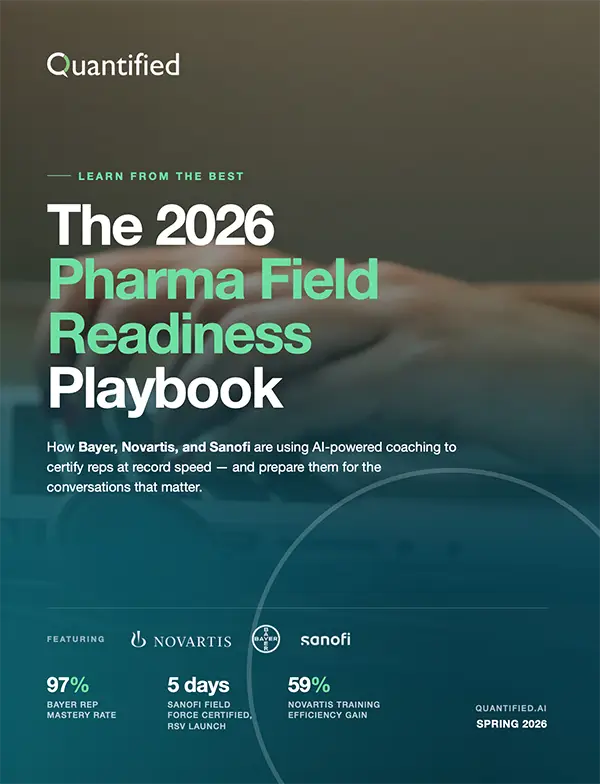
The 2026 Pharma Field Readiness Playbook
Download Now




The best pharmaceutical sales coaching tools combine AI-scored practice conversations, objective feedback on every rep, and reinforcement of approved messaging inside your compliance guardrails. The strongest platforms simulate real HCP objections at the specialty level, surface off-message moments for manager review, and connect rep capability to field readiness, which manual ride-alongs and one-off workshops cannot do at scale. In 2026, the tools pharma enablement teams evaluate most often are Quantified, Hyperbound, Second Nature, ACTO, SmartWinnr, Allego, Mindtickle, and Retorio, each strongest in a different part of the coaching stack.
Pharmaceutical sales coaching used to be a calendar problem: find time for ride-alongs, run an annual workshop, listen to a handful of calls. In 2026 it is a readiness problem. HCP access is more selective than it has ever been, reps often get a corridor minute instead of a scheduled detail, and every conversation has to land on approved messaging the first time. Veeva Pulse data shows that half of accessible HCPs now limit engagement to three or fewer biopharma companies. The teams that win those interactions are the ones whose reps rehearsed the conversation before they walked in.
That shift has changed what a coaching tool even means. The category now spans simulation, conversation analysis, microlearning, manager enablement, and readiness analytics, and the leading edge is pulling those pieces onto a single platform. This guide breaks down what pharmaceutical sales coaching tools do, the categories worth knowing, the named tools worth shortlisting, and where AI fits. If you are further along and evaluating a specific platform, the companion buyer's framework for AI sales coaching platforms covers vendor questions and red flags in detail.
Pharmaceutical sales coaching tools are the platforms and methods that help reps build, practice, and demonstrate the skills they need for compliant, effective HCP conversations. They range from manager-led coaching frameworks to AI-powered simulation platforms that let a rep rehearse a detail, get scored against approved messaging, and receive feedback in seconds.
The best tools do three things at once: build skill through repetition, measure it objectively, and keep practice aligned to what medical, legal, and regulatory teams have approved. Unlike general sales coaching software, pharma-specific tools have to account for therapeutic-area context, MLR-approved content, and short access windows. A tool built for B2B software sellers rarely survives contact with an oncology detail or a formulary objection.
Four realities make coaching both harder and more important than it was a few years ago:
Together these conditions explain why static, once-a-year coaching falls short, a pattern covered in more depth in Why Traditional Sales Roleplay Falls Short.
Most teams use a mix of the categories below. Knowing what each one is good at, and where it stops, helps you build a stack rather than buy overlapping point solutions.
| Tool Category | What It Does | Best For | Limitation |
|---|---|---|---|
| AI roleplay and simulation | Reps practice live HCP conversations against AI personas, scored against approved messaging | High-frequency, on-demand practice and certification at scale | Realism depends on specialty-level configuration, not a generic "doctor" persona |
| Conversation intelligence | Analyzes recorded live calls for talk ratios, keywords, and sentiment | Diagnosing what happened in real field conversations | Reviews the past; does not build the skill before the call. Recording HCP calls also raises trust and access concerns |
| Learning management and microlearning | Delivers and tracks structured content and short refreshers | Knowledge delivery and compliance documentation | Measures completion, not capability. Knowledge without practice rarely transfers |
| Manager coaching frameworks | Standardizes how managers observe, score, and give feedback | Consistent coaching language across a dispersed team | Only as scalable as manager time allows |
| Readiness and performance analytics | Connects practice and certification data to field metrics | Showing leadership where reps are ready and where they are not | Needs clean inputs from the practice and coaching layers to be useful |
The trend in 2026 is consolidation. Teams increasingly want the practice layer, the compliance reinforcement, the manager workflow, and the analytics on one engine rather than stitched across four vendors, so the content, scoring, and audit trail stay consistent end to end. The risk of recording-based tools specifically is worth a separate read, since surveillance-style approaches can erode the HCP trust reps depend on.
Across the platforms that move field performance, the same capabilities show up. Use this as a shortlist when you compare options:
"Best" depends on what you are solving for. The list below covers the eight tools pharma enablement and training teams evaluate most often in 2026, with the use case each fits best. One disclosure up front: Quantified publishes this guide, so read our entry knowing that, and verify the linked results yourself. The other entries reflect each vendor's published capabilities, and where a competitor is the better fit for a job, we say so.
Each tool was assessed against the capabilities above: specialty-level realism, approved-messaging reinforcement, personalization, objective scoring, manager workflow fit, platform consolidation, and field-connected measurement, plus security posture and published pharma outcomes. Sources include vendor documentation, published case studies, third-party review platforms, and our own head-to-head competitive evaluations.
Quantified is the AI sales coaching platform built for life sciences. Six integrated agents (roleplay, readiness coaching, field coaching, authoring, compliance, and insights) run on one Adaptive AI engine with a shared content library, a single scoring model, and one audit trail. Across 30+ life sciences enterprise deployments, including 10 of the world's largest pharmaceutical companies, customers report a 6x increase in rep practice, a 40% reduction in time to readiness, and a 19% increase in good selling outcomes. If your reps sell in regulated HCP conversations, this is the platform case in this guide. See the platform overview.
Hyperbound is an AI roleplay platform strongest in high-volume phone practice: cold calls, warm calls, and discovery, with realistic interruptions, tone shifts, and background noise. Its customer base sits in tech and general B2B, and its scoring evaluates sales technique rather than regulatory readiness. SDR organizations doing heavy outbound may find it the right fit; pharma teams that need MLR-aware certification will outgrow it quickly. Full breakdown in Quantified vs. Hyperbound.
Second Nature offers conversational AI practice with quick setup and a gamified experience suited to smaller teams and single-team rollouts. Its practice flows are more scripted than adaptive, and it measures participation more than behavioral performance, which limits it for enterprise pharma deployments that need governance controls and auditable scoring. For a small team that wants reps talking out loud this week, it does the job. Full breakdown in Quantified vs. Second Nature.
ACTO is a pharma-specific learning platform with strength in field content delivery and LMS-style compliance documentation. It is one of the few tools on this list built exclusively for life sciences, and it shows in the content workflows. Its roots are in delivery and completion tracking rather than behavioral scoring, and its AI roleplay capability arrived in late 2025, well behind the category leaders. Full breakdown in Quantified vs. ACTO.
SmartWinnr combines gamified quizzes, leaderboards, and microlearning with strong multilingual reach, and it has real traction with pharma field teams. It is effective at knowledge reinforcement, keeping product facts and approved claims fresh between training events. What it measures is recall, not conversation behavior, so it works best paired with a practice layer rather than instead of one. Full breakdown in Quantified vs. SmartWinnr.
Allego is a revenue enablement suite spanning content management, digital sales rooms, conversation intelligence, and dialogue-based practice, with positioning across pharma, biotech, and medical devices. If your priority is consolidating content operations and buyer engagement in one suite, it belongs on your shortlist. Roleplay and coaching are modules rather than the product, and implementations typically run months rather than weeks. Full breakdown in Quantified vs. Allego.
Mindtickle is a sales readiness suite built for general B2B revenue teams: structured training paths, content management, call insights, and readiness indexes in one platform. It is a credible choice for organizations standardizing enablement across a large revenue org. Its architecture is enablement-first with AI coaching layered on, and pharma-specific requirements such as MLR-aware scoring and approved-content guardrails take configuration rather than coming native.
Retorio is a video-based AI coaching platform focused on behavioral feedback: message delivery, clarity, and nonverbal presence, with HCP persona simulations for pharma teams. It is EU-hosted, ISO 27001 certified, and aligned to GDPR and the EU AI Act, which matters for European deployments, and it can be trained on MLR-approved materials. Its breadth spans sales, service, and leadership coaching, so its pharma certification depth is thinner than the purpose-built options on this list.
| Tool | Category | Best For | Pharma Depth |
|---|---|---|---|
| Quantified | AI sales coaching platform | Life sciences teams running the full rep lifecycle on one engine | Purpose-built: MLR-aware scoring, named pharma deployments |
| Hyperbound | AI roleplay | High-volume outbound and discovery call practice | Limited: built for tech and general B2B |
| Second Nature | AI roleplay | Lightweight practice for smaller teams | Limited: no compliance-grade scoring |
| ACTO | Pharma learning management | Field learning content and compliance documentation | Strong on documentation; light on behavioral scoring |
| SmartWinnr | Microlearning and gamification | Knowledge reinforcement and multilingual quizzing | Moderate: pharma traction, recall-focused |
| Allego | Enablement suite | Content management plus digital sales rooms | Moderate: configurable, not MLR-native |
| Mindtickle | Sales readiness suite | General B2B readiness programs | Limited: enablement-first architecture |
| Retorio | Behavioral AI coaching | Communication delivery and nonverbal feedback | Moderate: EU-hosted, trainable on approved content |
Use the categories table earlier in this guide to decide which kind of tool you need first, then use this list to shortlist within that category. The selection sequence later in this guide will pressure-test your finalists.
| Dimension | Traditional Coaching | AI-Powered Coaching Tools |
|---|---|---|
| Availability | Scheduled time with a manager or peer | On-demand, any device, as many reps as needed at once |
| Consistency | Varies by who is coaching that day | Same rubric and scoring every session |
| Personalization | One path for everyone | Adapts to each rep's tenure and proficiency |
| Compliance | Relies on a manager to catch off-message language | Reinforces approved messaging and surfaces off-message moments for review |
| Practice volume | Limited by coach availability | Effectively unlimited repetition per rep |
| Specialty realism | Depends on the coach's experience | Configurable personas by specialty and therapeutic area |
| Measurement | Subjective notes | Quantitative scoring tied to readiness data |
The point is not to remove managers. It is to give them leverage. AI handles the repetition and the objective measurement; managers spend their limited time on the judgment and relationship coaching that only they can provide.
AI moved coaching from something that happens occasionally to something that happens on demand. A rep can run a specialty-specific scenario before a launch detail, get scored against approved messaging in seconds, and run it again to apply the feedback. For a 500-rep field force, the difference between every rep getting two practice reps before a launch and twenty is the difference between a message that pulls through and one that fades.
The bigger shift in 2026 is structural. The market is moving from point tools, a roleplay app here, a call-analytics tool there, toward a continuous coaching platform that runs the full rep lifecycle on one engine: onboarding, preparation, field execution, reflection, and improvement. That is the model behind Quantified's AI Sales Coaching Platform, built on Adaptive AI, a fine-tuned private model purpose-built for life sciences commercial conversations. Because it is trained on regulated-industry data and hosted in a private environment that meets large-pharma security requirements, it behaves like a tool made for the field rather than a general-purpose model adapted after the fact. Adaptive AI also personalizes coaching to each rep's role, tenure, and demonstrated proficiency, so a new hire and a tenured specialist follow different paths.
The platform replaces six separate tools with six integrated agents, each drawing on the same engine, content library, and scoring model:
The proof shows up in the field. Across 30+ life sciences enterprise deployments, including 10 of the world's largest pharmaceutical companies (among them Astellas, J&J, Takeda, Novartis, Sanofi, Bayer, Otsuka, and Vantive), customers report a 6x increase in rep practice and preparation, a 40% reduction in time to readiness, and a 19% increase in good selling outcomes. Individual programs back that up: preparing more than 500 reps for a launch, Bayer ran 4,500-plus AI-driven practice sessions and reached a 97% mastery rate, and Novartis compressed onboarding from five weeks to just over two. These outcomes come from a platform built for regulated conditions, not generic roleplay adapted to a life sciences logo. For the full capability set, see the platform overview and the pharmaceutical industry page.
Start with the conversation your reps have, then work backward. If your reps get short, specialty-specific HCP windows, prioritize realism and approved-messaging reinforcement over content volume. If adoption has stalled before, weight the manager workflow heavily, because a tool managers do not use produces unmanaged practice and flat outcomes.
The first decision is usually point tool or platform. A single-purpose roleplay or call-analytics tool can solve one problem, but it leaves your content, scoring, and reporting split across vendors. A platform that runs the lifecycle on one engine keeps them connected, which matters most in regulated environments where the audit trail has to hold up.
A simple sequence works: confirm the tool can reinforce your approved messaging, validate the realism in a live simulation rather than on slides, and test the manager review flow with an actual frontline manager before you commit. For the full evaluation, including the seven questions to ask every vendor and the red flags that should end an evaluation early, use the companion buyer's framework for AI sales coaching platforms in pharma.
The best pharmaceutical sales coaching tools do not just deliver content. They build the skill, measure it against approved standards, and give managers the data to coach what is breaking down before it costs an HCP conversation.
Quantified is the AI sales coaching platform for life sciences commercial teams. Built on Adaptive AI, an MLR-aware governance layer, and six integrated agents across the rep lifecycle, it lets every rep practice approved messaging, certify on the plays that matter, and keep improving in the field. To see how leading teams are rethinking readiness and certification in a more selective access environment, start with the 2026 Pharma Field Readiness Playbook.
If your team sells in life sciences or another highly regulated industry, this is the platform worth evaluating. See Quantified's AI Roleplay and AI Sales Coaching Platform in action.
It depends on the job. Quantified is the strongest fit for life sciences teams that need AI roleplay, certification, compliance support, and coaching on one platform. Hyperbound leads for high-volume outbound call practice, ACTO for pharma learning management, SmartWinnr for gamified knowledge reinforcement, Allego and Mindtickle for broad enablement suites, Second Nature for lightweight practice, and Retorio for behavioral and nonverbal feedback.
Pharmaceutical sales coaching tools are platforms and methods that help reps build, practice, and demonstrate the skills needed for compliant, effective HCP conversations. They span AI roleplay and simulation, conversation intelligence, microlearning, manager coaching frameworks, and readiness analytics. The strongest tools reinforce approved messaging, score every rep objectively, and connect practice to field outcomes.
Look for specialty-level realism, reinforcement of MLR-approved messaging with reviewable session records, personalization to each rep's tenure and proficiency, consistent objective scoring, a manager review workflow that fits a real week, on-demand practice, and measurement that ties capability to ramp time and message pull-through. Avoid generic personas and tools that cannot align to your approved content.
AI lets reps practice realistic HCP conversations on demand, scored in seconds against approved messaging, with unlimited repetition. The newest platforms run the full rep lifecycle on one engine, using specialized agents for practice, readiness, field coaching, compliance, authoring, and insights, and use Adaptive AI to personalize coaching to each rep's tenure and proficiency.
Separate tools can work, but they fragment your content, scoring, and reporting across vendors, which makes consistency and compliance harder. The 2026 trend is consolidation onto one engine, where practice, coaching, certification, authoring, compliance, and insights share a content library, a scoring model, and an audit trail. Platforms such as Quantified run all six on Adaptive AI, so the signal stays consistent and the intelligence compounds across the rep lifecycle.
Pharma-built tools configure practice against approved messaging, surface off-message or off-label language for manager and brand review, and produce reviewable records of each session. This narrows the gap between what reps rehearse and what they are cleared to say, and gives training and compliance teams visibility into adherence. Tools should support compliance review and OPDP adherence rather than claim to guarantee compliance.
Track leading indicators first: practice frequency, certification pass rates, and message adherence in scored practice. Then track lagging indicators: time to readiness, message pull-through in the field, and selling outcomes for trained cohorts. Published pharma deployments report a 6x increase in practice, a 40% reduction in time to readiness, and a 19% increase in good selling outcomes when the tool is configured for the field.