Using AI to Boost Growth and Pharma Field Force Productivity
Download Now



Most pharmaceutical sales training programs aren't failing because of bad intent. They're failing because the model they're built on was designed for a different era: one where reps had reliable HCP access, launches weren't scrutinized from day one, and training teams had the bandwidth to certify hundreds of reps manually.
That era is over. The gap between how pharma trains reps and what it actually takes to perform in the field has never been wider.
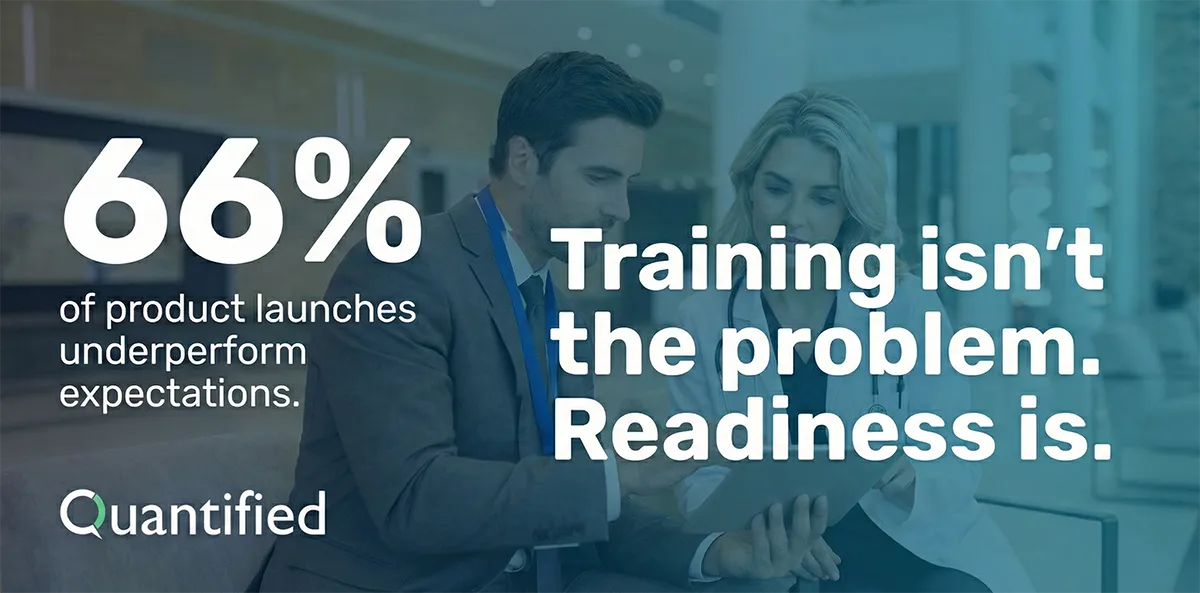
The structural challenges facing pharmaceutical field forces aren't anecdotal. Rep-accessible physicians stood at 80% in 2008, bottomed out at roughly 20% during the pandemic, and while access has partially recovered, HCPs are now far more selective. More than 50% limit meetings to three or fewer companies, according to Veeva Pulse Field Trends data analyzing over 600 million HCP interactions. Sales rep turnover runs at roughly 35% annually, which means training teams are perpetually rebuilding readiness from scratch. And despite constant investment in training, 66% of product launches still underperform expectations.
What's striking is that none of these problems are primarily caused by a lack of content. Most pharmaceutical reps receive substantial training on clinical data, on messaging, on product positioning. The failure isn't informational. It's behavioral. Reps know what to say. They haven't practiced saying it enough to perform under pressure, in real HCP conversations, on topics where a single off-label comment carries regulatory consequences.
The distinction between knowing and being ready is where most training programs fall short.
Classroom training and ride-alongs have real value, but they share a critical limitation: they don't create enough opportunities to practice in high-stakes, realistic conditions before those conditions actually occur.
The math is straightforward. A typical pharmaceutical rep has roughly five HCP conversations per day. At 20,000 customer-facing roles across a large pharma organization, that's 100,000 conversations happening daily, each one a chance to demonstrate value or waste a rare access window. No training program built around periodic workshops and manager-led roleplay can prepare reps for that volume and variability.
Certification creates a different problem. The biggest bottleneck isn't building the content or setting the standard. It's trainer availability. Certifying a field force manually requires managers to schedule, attend, and evaluate hundreds of individual sessions. It's slow, resource-intensive, and inconsistent. Different evaluators score the same performance differently, which means "certified" doesn't always mean the same thing. This problem is particularly acute heading into National Sales Meetings, where the pressure to certify hundreds of reps in a compressed window pushes training teams to their limits.
The result is a field force that is technically trained but operationally unprepared, deployed into a market where every conversation has to count.
AI roleplay isn't a replacement for human coaching. It's what makes human coaching more effective by handling the things coaching can't scale to do.
Specifically, it solves three problems that traditional training leaves unaddressed.
Practice volume. An AI simulator is always available. Reps can run sessions before a launch, before a difficult conversation, or whenever they feel underprepared, without requiring manager time. Organizations that use AI roleplay see reps completing six times more practice sessions than those relying on traditional methods.
Certification throughput. When certification is AI-assisted, the bottleneck disappears. Sanofi used AI-powered certification to certify 100% of its field force ahead of a critical RSV launch, saving more than 250 hours of manager time in a single cycle. That's not incremental improvement. That's a fundamental change in how quickly a commercial organization can get a field force ready.
Objective, consistent assessment. AI evaluates behavioral performance across more than a thousand signals: word choice, message structure, visual delivery, eye contact, tone, pacing, and emotional presence. It doesn't vary by evaluator, fatigue, or familiarity with the rep. Every performance is scored against the same standard, which makes certification meaningful and improvement measurable.
Novartis saw a 25% improvement in selling skills after deploying AI roleplay, and reps who engaged with the simulator were 26% more likely to reach President's Club. Across Quantified's customer base, organizations are seeing a 42% reduction in ramp time, a 57% improvement in positive call outcomes, and a 19% increase in revenue per sales rep.
These aren't soft efficiency gains. They're commercial outcomes tied directly to field force readiness.
Generic sales training tools aren't designed for pharmaceutical environments. The regulatory context matters enormously. Reps operate under strict FDA promotional guidelines, and off-label claims carry real legal and compliance risk. MLR review processes mean every piece of training content has to be vetted before it's deployed, and any platform used for certification needs to be defensible to Legal and Compliance, not just L&D.
That's why AI roleplay in pharma isn't simply a coaching feature. It's a compliance infrastructure. When certification is AI-assisted, there's an auditable record of who practiced what, when, how they scored, and whether they met the standard. That documentation protects the organization and gives L&D leaders something they've rarely had before: objective proof that the field is ready.
For a deeper look at where pharma organizations most commonly go wrong when implementing AI training, including the compliance assumptions that backfire, see What Pharma Gets Wrong About AI Training.
The question isn't whether AI-powered practice and certification will become standard in pharmaceutical commercial training. It's whether your organization adopts it before or after your competitors do.
The reps who get more practice before launch conversations perform better in those conversations. The organizations that can certify faster can launch faster. The L&D teams that can demonstrate objective, measurable readiness are the ones that will earn the credibility and budget to build world-class field forces.
Readiness isn't a training event. It's a measurable state. And it's now possible to know, with precision, whether your field force has reached it.
Want to see what that looks like in practice? Explore how Quantified works for pharmaceutical commercial teams or request a demo.
Quantified is the platform global Life Sciences leaders rely on to prepare their teams for onboarding, certification, product launch, and every crucial conversation in between. Learn more.