The 2026 Pharma Field Readiness Playbook
Download Now


Pharma sales enablement leaders are evaluating AI roleplay platforms in 2026 against a backdrop most software buyers do not face. HCP access is more selective than it used to be. Veeva has reported that half of accessible HCPs limit engagement to three or fewer biopharmas, while rep access has only partially recovered from pandemic-era lows. Every interaction has to land. Every rep has to be ready before the door opens, not after.
That pressure has produced a wave of vendors promising “AI sales coaching” as the answer. Most of them are not built for the constraints that define pharmaceutical selling. The question for enablement leaders is no longer whether to add AI to the coaching stack. It is which platform can hold up to compliance scrutiny, simulate the conversations reps will have in the field, and fit into how field managers already work.
Three pillars decide that answer: compliance architecture, objection realism, and manager workflow. A platform that misses any of the three creates risk faster than it produces readiness. This guide walks through what each pillar looks like in practice, where most coaching software fails the pharma test, and what to ask vendors before signing.
The economics of HCP engagement have inverted. Before the pandemic, pharma reps made roughly 700 million physician visits a year, and access was abundant. Today, 86% of HCPs say they prefer digital channels for routine product updates, and only 28% believe pharma’s digital outreach is effective, against 82% of pharma leaders who think it is. The volume conversation is over. The quality conversation has replaced it.
That shifts the burden onto training and coaching. When a rep gets one shot at a busy oncologist or a skeptical cardiologist, the conversation has to be sharp, compliant, and tailored to that physician’s specific concerns. Traditional certification, classroom workshops, and ride-along coaching cannot scale to that standard. Manual roleplay is inconsistent. Manager bandwidth is finite. The forgetting curve eats most knowledge transfer within a week. AI roleplay is one of the few mechanisms that can produce enough repetition, specificity, and feedback for reps to enter real HCP conversations prepared.
But the technology category is uneven. Many AI coaching platforms were built for B2B SaaS sellers, customer service teams, or insurance agents and ported into life sciences with minor adjustments. They look the same on a demo. They behave very differently when a brand team, an MLR reviewer, or a frontline sales manager touches them.
Traditional sales coaching software fails pharmaceutical teams for four structural reasons, none of which can be fixed by adding more content to the library.
Generic objection sets that do not reflect real HCP conversations. Most coaching platforms ship with scenarios built for software, financial services, or general B2B sales. An oncologist asking about progression-free survival data, a cardiologist comparing efficacy across a drug class, or a busy primary care physician deflecting because their formulary already covers a competitor product does not appear in a generic library. Reps practice on conversations they will never have.
No on-label guardrails inside the simulation itself. A B2B SaaS coaching tool has no concept of approved messaging. A pharma rep who drifts off-label inside a generic AI roleplay gets feedback that the close was strong. The reviewer never sees that the rep made a claim the brand team has not cleared. Compliance becomes a downstream cleanup problem instead of a training input.
No integration with the MLR cycle. Medical, legal, and regulatory review cycles can stretch for weeks, especially when content, claims, references, and reviewer feedback are managed across disconnected workflows. When training scenarios live outside that workflow, every product update, label change, or competitive response requires duplicate review. Most coaching platforms cannot ingest MLR-approved materials and turn them into practice scenarios fast enough to keep pace with brand teams.
A coaching workflow built around an unrealistic view of the pharma frontline manager. Generic coaching software assumes a sales manager who has time to listen to call recordings, watch roleplay video, and write feedback. Pharma frontline managers split time across coaching, ride-alongs, compliance oversight, and their own commercial responsibilities. A workflow that requires 30 minutes of manager review per rep per week does not survive contact with their calendar.
For enablement teams that have tried to retrofit traditional coaching software onto pharma, the symptom is familiar. Adoption stalls after onboarding. Managers do not log in. Brand teams stop submitting new scenarios. The platform becomes a sunk cost rather than a performance system. The Hidden Cost of Call Recording problem follows the same pattern: surveillance-style tools fail in regulated environments because they were not built for them in the first place.
Even platforms that brand themselves as “pharma-ready” often miss the real conversation. Three failure modes explain why.
The AI persona is generic. A simulated HCP that responds to any question with reasonable, polite engagement is not modeling reality. Real oncologists interrupt. Real cardiologists open with “I have 90 seconds.” Real psychiatrists raise specific concerns about side effect profiles in elderly patients. If the simulation cannot reproduce that specificity, reps practice on a smoothed-out version of a conversation that does not exist.
Therapeutic-area context is missing. Pharma selling does not happen in a vacuum. It happens inside a formulary position, a payer mix, a prior authorization landscape, a competitive switch dynamic, and a patient population the HCP treats every day. A coaching platform that simulates “an HCP” without modeling those constraints produces reps who can answer textbook objections and fail at the real ones. A specialty pharmacy dynamic in rare disease looks nothing like a primary care detail.
The conversation length does not match the field. Many AI roleplay tools simulate 15 to 20 minute conversations. Pharma reps frequently get 90 seconds in the corridor, 5 minutes between patients, or a quick lunch slot. Building muscle memory for an extended discovery conversation does not prepare a rep for the access reality of 2026. Platforms that cannot configure scenarios to match real call cadence produce confident reps in long-form conversations and unprepared reps in the conversations they get instead.
The pattern across all three failures is the same. Generic AI is plausible on a demo. It does not hold up when a brand team, an enablement leader, or a top rep tests it against the conversations they know.
The platforms that work for pharma share an architecture, not a feature list. They are built around three pillars.
In a pharma-built platform, simulations should be configured against approved messaging, with guardrails that identify off-label language, missing required claims, or prohibited phrases during practice. Each session should produce a reviewable record that helps training, brand, and compliance teams understand how reps performed against the approved rubric. Brand teams treat the platform as an extension of MLR governance, not a separate compliance surface to manage.
This matters for two reasons. First, it narrows the gap between training and field reality. Reps do not learn one set of language in coaching and discover a different set is approved for HCP conversations. Second, it shortens the cycle when label changes, indications, or competitive responses require new training. Approved content can be converted into practice scenarios without forcing teams to rebuild the training workflow from scratch.
The platform models HCPs at the specialty level, not at the generic “doctor” level. Oncology personas behave differently from primary care personas. Endocrinologists ask different questions than pulmonologists. Scenarios reflect the real cadence of an HCP interaction, including short corridor conversations, scheduled detail sessions, and full advisory board exchanges. Objections are drawn from the specific objections that brand teams hear in the field, not from a generic library written years ago for a different industry.
The customers Quantified works with at Bayer, Sanofi, Novartis, Astellas, and Takeda built specialty-specific scenarios because their reps face specialty-specific conversations. The platforms that perform in pilots are the ones that let brand teams configure realism, not the ones that ship with fixed personas.
The platform fits the frontline manager’s actual week, not a hypothetical one. Manager review surfaces include short summaries, scoring against the rubric the manager is already accountable for, and direct coaching opportunities the manager can act on in five to ten minutes per rep. Practice frequency and improvement trajectory show up as data, not as another inbox the manager has to read. The coaching loop closes in the time the manager has, not in time the manager would need to invent.
Manager workflow is the pillar most platforms ignore on the demo and most enablement teams discover too late. A platform that drives rep practice but fails to integrate manager review produces unmanaged practice. Outcomes plateau. Adoption decays.
The outcomes that follow when all three pillars are built correctly are measurable. Across Quantified deployments, teams have reported 60% faster certification, 42% ramp reduction, six times more practice volume than traditional methods, and 97% mastery rates on certification rubrics. In pharma-specific programs, published customer outcomes include Sanofi certifying 80% of learners within 48 hours and 100% within five days, and Novartis reporting a 59% training efficiency improvement with a 95% first-time pass rate. Those numbers do not come from generic AI roleplay. They come from platforms built around pharma’s specific constraints from the ground up.
Vendor demos hide the pillars. Real evaluation surfaces them. These seven questions separate platforms built for pharma from platforms ported into it.
On compliance:
On objection realism:
On manager workflow:
Any vendor that cannot answer these questions concretely should not advance far in a pharma evaluation. Any vendor that can answer all seven concretely is worth a pilot.
The fastest way to compress the evaluation cycle is to disqualify vendors who fail clear tests. Five red flags should end the conversation.
A correctly chosen platform shows specific outcomes in the first quarter of use. The leading indicators show up first. Practice frequency lifts, with reps logging multiple sessions per week on their own time. Completion rates on assigned scenarios reach the high 80s or 90s. Manager engagement holds steady or grows, because the workflow fits their week.
The lagging indicators follow. Certification pass rates improve, often substantially. Ramp time for new hires shortens by weeks. Message pull-through, measured by what reps say in the field versus what brand teams approved, tightens. Pharma teams benchmarking against published customer outcomes can look at Sanofi’s full-team certification within five days and Novartis’s 95% first-time pass rate as practical reference points for what a correctly configured rollout can produce.
If the first 90 days do not produce those indicators, the issue is rarely user adoption. It is usually a pillar that was not built correctly during the pilot configuration. Compliance architecture that was bolted on rather than designed in. Personas that were generic rather than specialty-specific. Manager workflow that was not validated with actual managers before launch. Any of those gaps shows up in the data quickly.
The vendor landscape for AI sales coaching in pharma will keep expanding. The buyer’s framework does not need to. Compliance architecture, objection realism, and manager workflow are the three pillars that determine whether a platform produces field readiness or another adoption problem.
Lead the evaluation with compliance. Validate realism in a working simulation, not on slides. Test the manager workflow with a real frontline manager before signing. The platforms that hold up to that sequence are the ones worth piloting. The platforms that fail any of the three will fail in the field, regardless of how confident the demo looked.
The pharma sales coaching decision is not “AI versus no AI” in 2026. It is “AI that was built for our constraints, or AI that was ported into them.” The cost of getting that wrong is paid in HCP conversations that did not land, certifications that did not stick, and managers who stopped logging in.
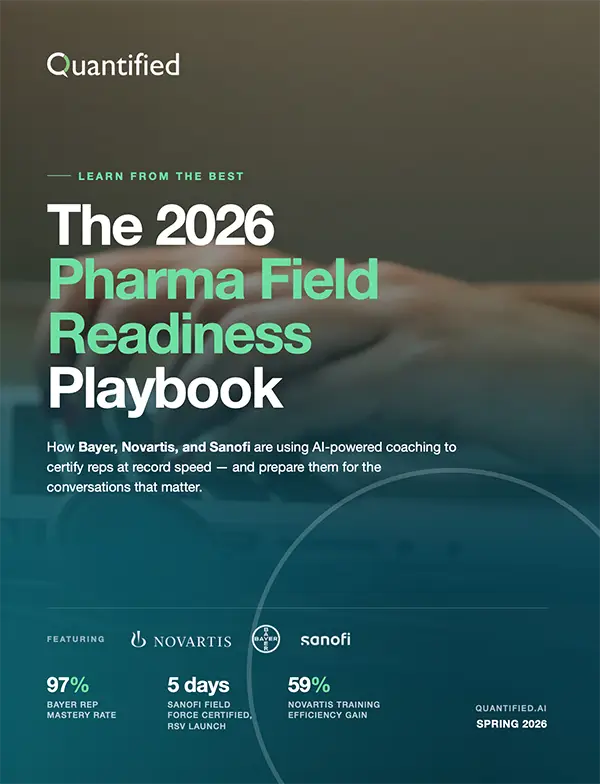
The 2026 Pharma Field Readiness Playbook shows how leading pharma teams are rethinking readiness, certification, and field coaching in a more selective HCP access environment. Use it alongside this buyer framework to pressure-test your next platform evaluation.
Download the 2026 Pharma Field Readiness Playbook →
Or schedule a custom demo to see how Quantified configures the three pillars for pharma teams.
AI sales coaching platforms for pharmaceutical sales are simulation-based training systems that let reps practice realistic HCP conversations against AI personas configured to specialty, therapeutic area, and approved messaging. The strongest platforms include on-label compliance guardrails, MLR-aligned content workflows, and scoring designed for pharma frontline manager review.
Traditional coaching software was built for B2B SaaS or general sales. It lacks on-label guardrails, does not connect to the MLR cycle, ships with generic objections, and assumes a manager workflow pharma frontline leaders do not have time for. Adoption fades because the platform was never designed for the constraints pharma teams operate under.
Generic AI personas, missing therapeutic-area context, and conversation lengths that do not match the field. Pharma reps face specialty-specific objections, formulary and payer constraints, and short access windows. Platforms that cannot model those conditions produce reps who practice on conversations they will never have.
The platforms that work for pharma build three pillars: compliance architecture aligned to approved messaging, objection realism configured at the specialty and therapeutic-area level, and a manager workflow that fits the frontline manager’s real week. Together they produce measurable outcomes, including faster certification, shorter ramp time, and stronger message pull-through.
Named top-25 pharma customers past pilot, configurable specialty personas, MLR content ingestion, reviewable session records, and a manager review workflow validated with real frontline managers. Disqualify vendors with fixed personas, unsupported compliance reduction claims, or pilot timelines that do not fit a launch window.
A pharma-built AI roleplay platform should run simulations configured against approved messaging, with guardrails that identify off-label language, missing required claims, or prohibited phrases during practice. Each session should produce a reviewable record that helps training, brand, and compliance teams understand how reps performed against the approved rubric.