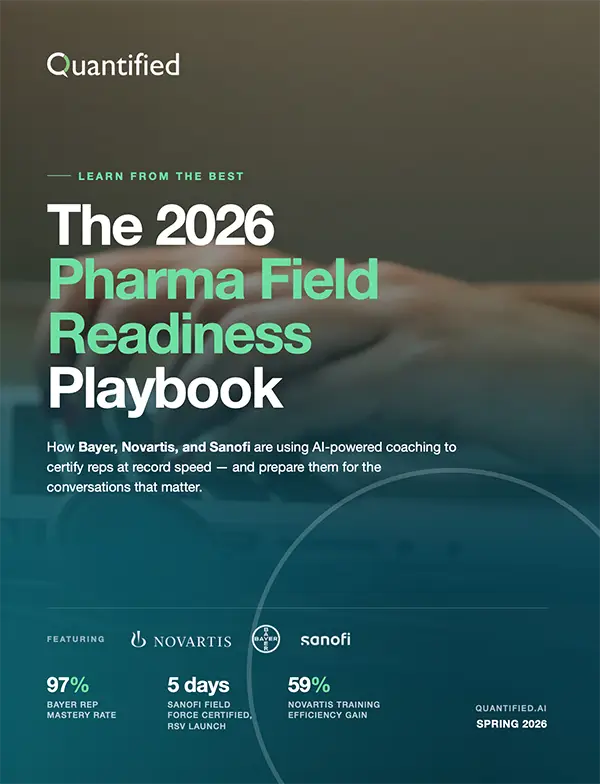
The 2026 Pharma Field Readiness Playbook
Download Now


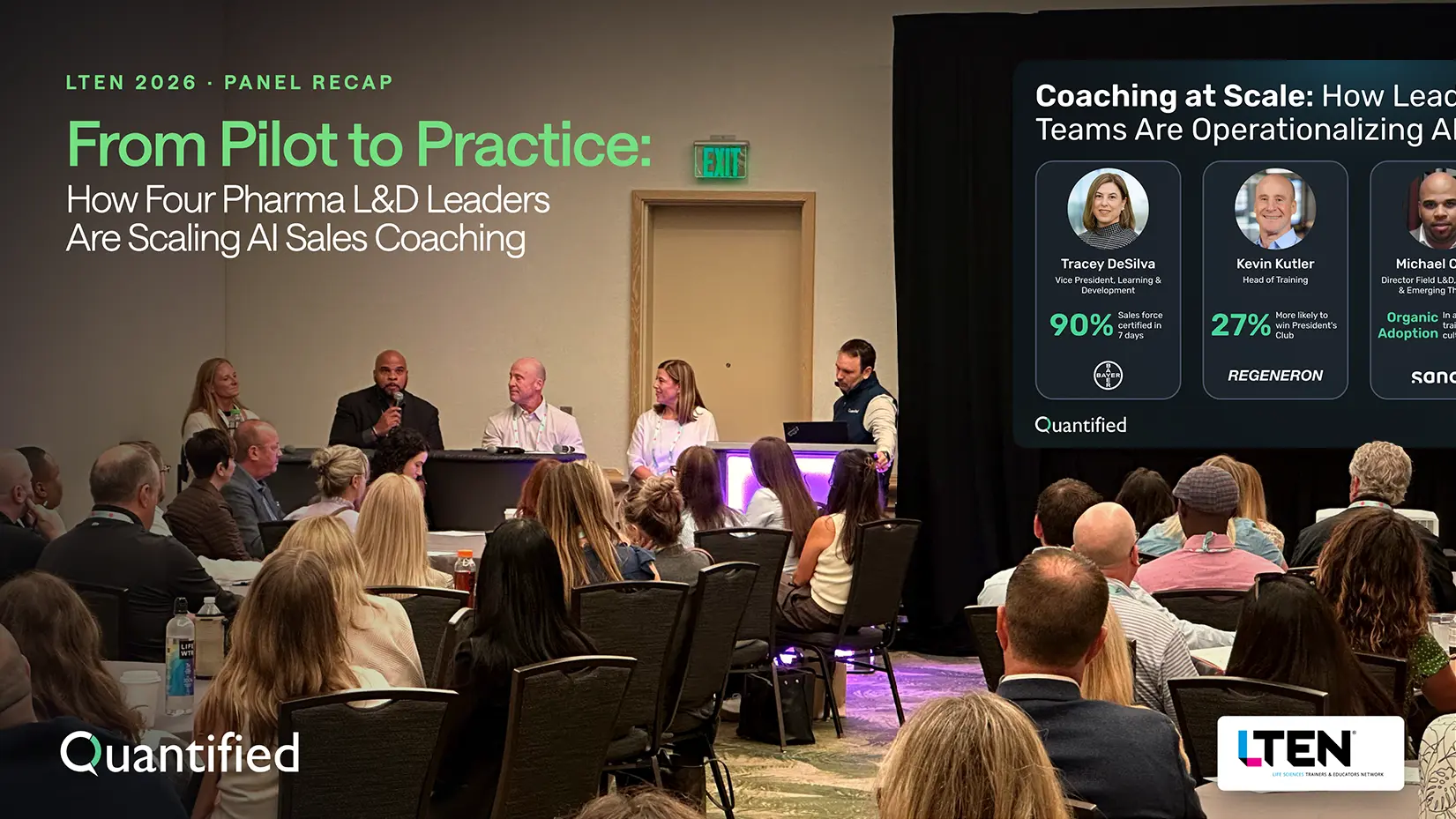

At LTEN 2026, four training leaders from Bayer, Regeneron, Sanofi, and UCB sat down to talk about something every life sciences L&D team is wrestling with right now: how to actually operationalize AI sales coaching inside a regulated pharma environment.
Nobody on the panel was making the case for whether AI roleplay creates value. That conversation is over. The harder question, and the one you’re probably sitting with, is how to bring this work into your organization, get it approved, and scale it.
Here are the numbers that anchored the panel. Tracey DeSilva at Bayer saved roughly 800 trainer hours in 2025 while certifying 90 percent of the sales force in seven days, down from the traditional five weeks. Kevin Kutler at Regeneron pointed to industry data showing reps who practiced with simulation were 27 percent more likely to win President’s Club. Mike Coney at Sanofi described organic adoption spreading peer-to-peer in a culture that’s historically pushed back on formal training. And Angela Sayre at UCB took her team from no visibility into rep practice to weekly dashboards across an entire therapeutic area in 90 days, with 95 percent participation and 16 practice sessions per user on average.
The four leaders walked the audience through the journey: deciding to implement, operationalizing, deploying, and expanding. Here’s what stood out.
Kevin spent more than two years building the internal case before Regeneron moved forward. He works inside a company with one of the strictest compliance postures in the industry, and the conversation only shifted when he found an analogy that landed with the people who needed to greenlight it. “Your daughter is a Navy pilot. Did they give her a license without simulator training?” Practice is a universally accepted concept. Once that framing was on the table, the conversation moved.
The other panelists came in through different doors. Tracey was reviewing 2,000+ certifications across multiple launches, which necessitated a faster, more scalable approach. She also reframed L&D’s seat at the table, asking, “How do we tell the story that L&D can be a pioneer too?” Mike joined Sanofi after the vendor decision had already been made, so his question was different. Not “should we do this,” but “now what.”
Every organization has a different reason for getting started. The leaders who made it through didn’t import someone else’s case. They built the one that fit their company’s actual pressure point.
The hardest part of bringing AI roleplay into pharma isn’t usually the technology. It’s everything that has to happen around it.
Mike walked through how Sanofi’s operations team led the conversation with legal and regulatory, rather than waiting for compliance to come back with a verdict. The insight that unlocked the work was simple: AI simulations use content that’s already been through MLR. There’s no duplicate review needed. Add disclaimers, define the boundaries, and compliance starts behaving like a partner instead of a gatekeeper.
Culture was the other half of the work. Mike pushed back on a sales leader who wanted to use simulation scores to monitor reps. He reframed the tool as a place to stretch capability, not a place to be evaluated. That reframe protected adoption. In a culture that’s historically resisted formal training, no sales leader at Sanofi has said, “I don’t want this.”
Compliance moves faster when you lead with what’s already approved. Adoption holds when reps know they’re practicing, not being graded.
Angela’s story is one most L&D leaders in this audience could see themselves living. The week before a launch meeting, an IT security update blocked portal access to the platform. Her team pivoted, moved to pre-recorded demos, scaled back to a couple of regions, and kept a small testing pod of field reps engaged throughout recovery. When they relaunched, leaders were brought into the decision first, then peer champions activated the rest of the field. One rep summed up the moment: “I really wanted to hate this and I don’t.”
Tracey took a different path. Bayer ran a 20-territory pilot against a control group, which gave sales leaders the data they needed to champion the program once they saw the results. Mike’s deployment surprise at Sanofi was different again. An unsolicited email from a rep praising the pilot showed up in his inbox, and peer-to-peer advocacy spread organically across the team from there.
Every deployment runs into something. What separated the leaders who succeeded was that they planned for that moment, and they built their adoption strategy around real human dynamics. Peer champions, sales leadership ownership, and organic momentum. Not top-down rollouts.
For Angela, the most important outcome of the UCB rollout wasn’t engagement or session counts. It was visibility. Before AI roleplay, the team had no real view into how reps were practicing, what they were struggling with, or whether anyone was practicing at all. Ninety days in, that picture had changed completely. Weekly dashboards across the entire therapeutic area now show where reps are spending their time, where they’re improving, and where managers need to coach. The 95 percent participation and 16 sessions per user only mean something because the team can finally see them.
Bayer is showing what gets built on that foundation. New hires are now in customer conversations within 48 hours, compared to the traditional four to eight weeks. Tenured reps are being upskilled with persona-driven scenarios for upcoming launches. The trainer hours saved are being reinvested into higher-value coaching. L&D’s value at Bayer is shifting from courses delivered to business outcomes enabled.
What comes next is more ambitious. Tracey described a near-term vision where CRM data, operations data, and personalized practice prompts live in one place. The rep opens the platform and sees: this week your call plan should involve Dr. X, here’s the specific message to practice. AI personas tied to specific HCP segments and skills, with manager dashboards flagging exactly which reps are struggling with which messages.
Mike issued his team a 30/30/30 challenge: reduce L&D workload by 30 percent, get teams up to speed 30 percent faster, and improve training quality. He’s also focused on building simulations that serve both new hires and tenured reps without expiration-dating the content.
Kevin sees the ideal state as AI roleplay embedded directly in the platform reps already use every day, so it stops being a destination and starts being a layer of the workflow.
Scale is the moment this work stops being a project. You can’t manage what you can’t see, and the leaders who are scaling successfully are the ones who built measurement in from the start.
You’re probably sitting somewhere on this same journey. Maybe still building the internal case. Maybe figuring out what comes after the pilot. Maybe scaling and trying to keep pace with where the field is going.
The four leaders on stage didn’t agree on every detail. They did agree that the technology isn’t the hard part. The operational decisions are, and the teams getting it right are the ones treating compliance, culture, deployment, and measurement as four jobs that have to be done in parallel.
The field is moving fast. The vision Tracey described, where practice prompts tied to specific HCPs, personas, and messages surface inside the platform a rep already uses every day, is closer than most teams realize. The L&D teams that build durable programs over the next twelve months will be the ones doing the operational work right now to be ready for it.
See what AI sales coaching looks like when it’s built for life sciences L&D. Explore the Quantified platform →