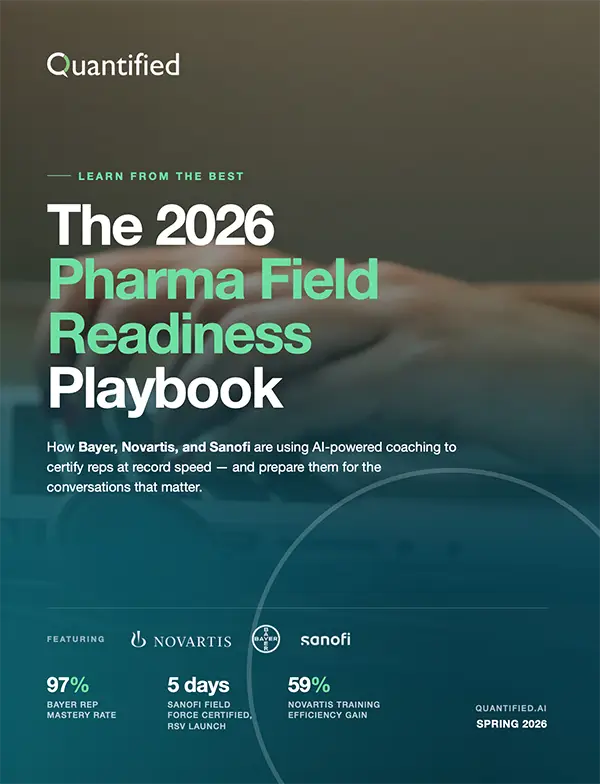
The 2026 Pharma Field Readiness Playbook
Download Now




The best pharma sales training programs in 2026 share six practices: role-based needs analysis, frequent spaced practice, objective certification before field deployment, compliance built into every practice conversation, coaching that continues in the field, and measurement of behavior change rather than course completion. AI now makes all six scalable across a large, distributed field force.
Too much pharma training still follows a model built around content delivery: a launch meeting, a binder, a manager-led roleplay, and a completion checkbox in the LMS. Reps may pass the assessment, but without continued practice and reinforcement, readiness fades quickly. The practices below replace that event-based model with a continuous system for preparing, certifying, and improving the field.
The six best practices, at a glance:
Pharma sales training is the structured process life sciences organizations use to prepare commercial field representatives for compliant, effective HCP conversations. It spans onboarding, product and disease-state knowledge, message certification, objection handling, and ongoing skill reinforcement. Unlike general sales training, it operates inside regulatory guardrails: reps must stay on-label, handle off-label questions correctly, and represent clinical data accurately in every interaction.
The discipline has widened. A decade ago, pharmaceutical sales training mostly meant product knowledge and a certification exam. Today the job is to produce, prove, and maintain field readiness against a moving target of new indications, tighter access, and compliance scrutiny, which is why program design now matters more than content volume. That readiness outcome, not course completion, is what modern AI sales coaching is built to produce.
Three constraints separate pharma from ordinary B2B sales enablement, and each one shapes what good training looks like.
First, access is scarce. Only 45% of HCPs are accessible to biopharma reps today, down from 60% eighteen months earlier, according to Veeva Pulse field data. When a rep gets a few minutes with a physician, there is no room to be underprepared. Every conversation has to count.
Second, the stakes are regulatory. An off-label claim or an unsupported efficacy statement is not a lost deal; it is a compliance event with legal and financial exposure. Training has to reinforce approved, MLR-cleared messaging every time, and it has to give compliance teams a record that reps were certified before deployment.
Third, launch cycles are relentless. Portfolio-heavy companies move from one indication, market expansion, and message update to the next. A field force that was ready for the previous launch is not automatically ready for a new patient profile, competitive objection, or clinical narrative. Training therefore cannot remain an onboarding event. It has to operate as a continuous readiness function.
The practices below move a program from content delivery to measurable field readiness. Treat them as a sequence: each one builds on the one before it.
Before building a single module, define what field-ready looks like for each role. A new primary-care rep, a tenured specialty rep, and an account manager preparing for a formulary conversation need different scenarios and different success criteria. The best programs write these criteria down as observable behaviors, not topics, so that everything downstream can be measured against them. This is also where the common onboarding-only trap gets avoided: training for tenured reps should target advanced objection handling and new-indication fluency, not a repeat of week-one basics.
The single biggest waste in pharma training is the one-and-done event. Research on the forgetting curve is blunt about why: within 30 days of a training event, about 79% of what was taught is forgotten, and much of that loss happens in the first week. Spaced practice counters that decay. Reps who revisit the same high-stakes scenarios repeatedly, with feedback each time, build durable muscle memory that a single national sales meeting cannot. This is where AI changes the economics: practice becomes on-demand and is no longer constrained by manager availability. Teams that adopt it commonly report roughly 6x more practice than they could support manually.
“Completed the course” and “ready for the field” are not the same claim. The best programs set an objective bar (a defined score across knowledge, message adherence, and communication behaviors) and require reps to clear it before they see a real HCP. Objective certification reduces the subjectivity of a manager ride-along, gives compliance a defensible record, and gives structure to formal certification programs. It is especially valuable during product launches, when commercial leaders need to know the field can deliver the approved message before deployment. When FDA approval arrived early for one oncology franchise, Bayer used AI-powered practice and certification to certify 90% of its roughly 300-rep field in seven days.
In regulated selling, compliance is not a module bolted on at the end; it is a dimension of every practice conversation. The strongest programs score message adherence and on-label behavior in the same session that scores selling skill, so reps learn to be persuasive and compliant at once. That also gives L&D a defensible story to tell upward: certified-before-field is a control the business can stand behind. An AI compliance agent can flag off-label drift during practice and generate audit-ready records, without turning managers into auditors.
Behavior changes where the work happens. Classroom certification gets a rep to the starting line, but pre-call preparation and post-call debriefs are where skills stick. The constraint has always been manager bandwidth: frontline managers cannot ride along on every call. An AI field coach helps close that gap with on-demand prep and structured debriefs between live coaching sessions, and it does so without recording live HCP conversations, which physicians resist and which carries its own compliance exposure. The goal is continuous coaching and reinforcement that runs year-round, not a burst of attention at launch.
The question buyers now ask is the right one: did the rep change how they act, or just check a knowledge box? Completion rates and satisfaction surveys measure activity, not readiness. Leading teams track practice frequency, message-adherence rates, behavioral improvement over time, and time-to-readiness, then look for reasonable connections to field outcomes. That shift from lag indicators to lead indicators is the heart of modern sales coaching effectiveness measurement in pharma. It is also what lets L&D show commercial value to sales leadership instead of reporting course-completion numbers the commercial side does not act on.
None of the six practices is new. What is new is that AI makes all six practical at the scale of a national field force. AI does not replace the trainer or the manager; it removes the capacity ceiling that kept best practice from reaching every rep. Purpose-built platforms can run realistic HCP simulations, evaluate performance against defined knowledge, message, compliance, and communication criteria, and tailor each rep's next session to their demonstrated needs through Adaptive AI.
In practice, that changes the operating model from a scheduled event to a continuous system. Reps practice on demand, get consistent, rubric-based feedback in minutes rather than days, and revisit weak spots as often as they need. Managers spend their limited coaching time where the data says it will matter most. The table contrasts the two models.
If you are evaluating platforms, four criteria separate tools that change field performance from tools that just add practice reps.
Quantified is the AI sales coaching and roleplay platform built for life sciences, and it is designed around those four criteria: pharma-specific simulations, compliance-aware scoring, and coaching that follows reps into the field. It is not the only option, and an honest evaluation should weigh the categories against each other. Learning management systems handle content and tracking but do not build conversational skill. Generalist roleplay tools such as Second Nature bring practice reps to any industry but lack the regulatory depth pharma requires. Conversation-intelligence tools score real calls after the fact, which reintroduces the recording and access problems above. For a category-by-category view, see our guide to the best pharmaceutical sales coaching tools, and for why live roleplay alone is not enough, read why traditional sales roleplay falls short.
Measure at three levels, and be honest about what training can and cannot claim on its own.
Resist the temptation to claim training alone moves quota, win rate, or revenue. Those outcomes are shaped by territory, access, product performance, and market conditions as much as by readiness. The credible story ties leading readiness indicators to operational gains, and then to commercial indicators where the link is defensible. For a practical starting point, Novartis rebuilt onboarding around AI simulations, and teams commonly report faster certification and roughly 42% shorter ramp. The complete guide to AI sales training for life sciences shows how the pieces fit together.
Pharma reps are trained through a mix of product and disease-state education, message and compliance certification, roleplay-based conversation practice, and in-field coaching. Modern programs add AI simulation so reps can practice realistic HCP conversations repeatedly and be certified against an objective standard before they enter the field, structured through new hire onboarding and ongoing reinforcement.
The forgetting curve describes how quickly people lose newly learned information without reinforcement. In sales training, roughly 79% of what is taught can be forgotten within 30 days, and much of that in the first week. Spaced, repeatable practice is the proven counter, which is why one-time launch meetings produce diminishing returns.
AI sales training can be effective for pharma when it is purpose-built for the regulatory context. Effective programs simulate HCP conversations, evaluate performance against clinical and compliance criteria, and deliver personalized coaching at scale. The gains typically show up as more frequent practice, faster certification, shorter ramp, and readiness data that manual, observation-based models cannot produce across a large field force. Tools that are not built for pharma tend to fall short on compliance and therapeutic realism.
The best platform depends on your priorities, but for life sciences the deciding factors are compliance architecture, objection realism, and manager workflow. Evaluate whether a tool scores message adherence, produces objective and repeatable certification records, and reinforces coaching in the field, not just whether it offers roleplay. Pharma-specific platforms like Quantified are built for these requirements; general tools usually are not.
Traditional onboarding often runs several weeks to months before a rep is field-ready. AI-powered practice and certification can compress that by increasing practice volume and certifying readiness objectively, with teams reporting roughly 42% faster ramp and, in launch scenarios, field certification in days rather than weeks.
Pick one high-stakes moment, most likely an upcoming launch or a large onboarding class, and rebuild it around these practices: role-based criteria, spaced practice, objective certification, and field reinforcement. Measure readiness before and after. For a ready-made framework, download the 2026 Pharma Field Readiness Playbook, or book a demo to see how leading pharma teams operationalize the six practices.