Using AI to Boost Growth and Pharma Field Force Productivity
Download Now


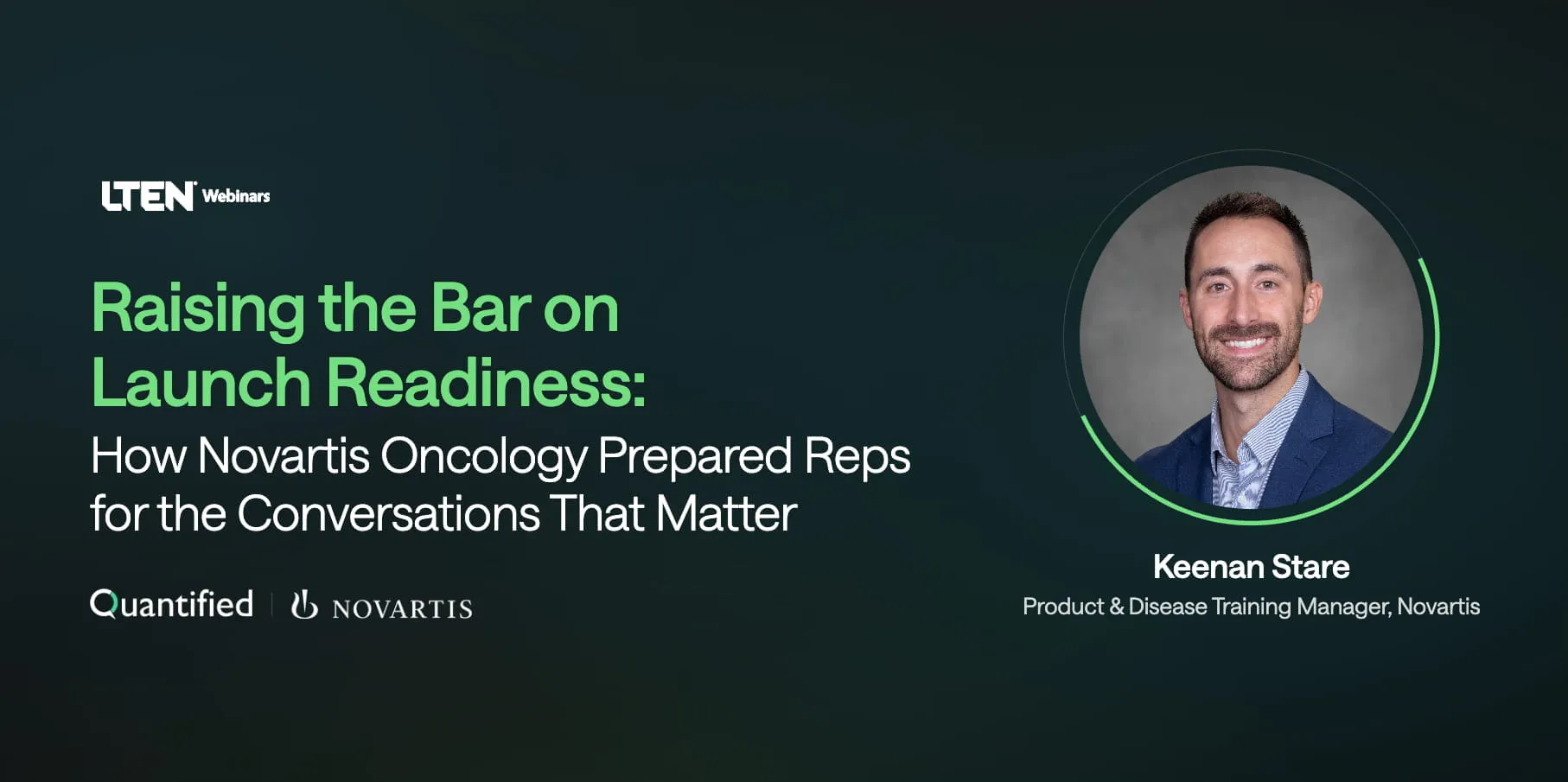

Could an experienced field force walk into a real HCP conversation and hold its own on a newly approved oncology indication, on a timeline that moved up by three months?
That was the subject of our recent LTEN webinar, Raising the Bar on Launch Readiness: How Novartis Oncology Prepared Reps for Conversations That Matter, where Keenan Stare, Product & Disease Training Manager at Novartis, joined Quantified CMO Wayne St. Amand to walk through how his team approached the launch, stage by stage.
Novartis was preparing to expand a therapeutic into earlier lines of care for an existing oncology indication. As the team's regulatory partners picked up on strong momentum in their ongoing conversations with the FDA, the internal timeline compressed by about three months.
That shift meant consolidating the traditional learning modalities the team had designed, while still building in meaningful moments for reps to apply the new information. It also meant rethinking not what readiness was, but how to make readiness consistent across an entire field team on a shorter clock. Certification had historically happened in person, at a launch meeting timed to approval. Running that same rigor virtually was possible, but it introduced a lot of codependencies and leaned hard on a large cross-functional team to pull off.
Keenan's answer to how his team solved for that breaks into five parts: the stakes that made readiness non-negotiable, what readiness actually meant beyond the label, how the team designed for it, where that design got tested once reps were in it, and what changed when the timeline itself did. Here's how each played out.
The stakes went beyond speed. The therapy was moving into a space with a strong, entrenched standard of care, and sales in the existing indication had plateaued. For Novartis, this expansion represented a chance to help more patients and recapture momentum for the brand across the full indication.
Moving into an earlier line of therapy also changed how reps had to think and talk with customers. Instead of the sequencing conversations reps were used to, this called for a conversation about intensification: how much therapy a given patient needs and deserves to get the outcome they are after. Internal research had already identified four sales capabilities that mattered across the entire indication, and Novartis needed a way to evaluate and benchmark reps against them so first-line leaders could coach with real signal, not guesswork.
Competency alone was not going to cut it, and Keenan was candid that this is a step a lot of training programs get wrong. The bar was whether reps could consistently translate new information into commercial impact in a live customer dialogue, not whether they could recite facts back on a quiz.
In practice, that meant reps had to build compelling narratives around an unmet patient need, even when the HCP across the table had years of confidence in the existing standard of care. It also meant navigating a much more heterogeneous patient population than the one reps were used to, which called for a more nuanced patient identification approach. The brand story did not change based on a patient's specific profile, but how a patient experienced the product's benefits did, so reps needed real storytelling skill, not memorized disease-state statistics, to make that land.
Three things drove the decision to build certification on Quantified.
Flexibility. Keenan's team had seen a full spectrum of simulations built by peers across both HCP and non-prescribing stakeholders, applied to a range of business objectives. That gave them confidence they could build a scenario relevant to their specific strategic priorities, whatever those turned out to be.
Feedback. Evaluation was objective and consistent, aligned to Novartis's own selling model rather than left to an individual evaluator's discretion or bias. The resulting data surfaced real trends. Novartis saw reps grow quickly in disease-state fluency with practice, for example, while softer, more abstract skills like storytelling sometimes stayed flatter, giving sales leaders a clear signal for where to coach next.
Operational efficiency. Once approval landed, Novartis had roughly a 24 to 48 hour window to get the team through certification, on top of a traditional model that depended on cross-functional partners who were already pulled into their own launch priorities. Quantified let reps certify on their own schedule rather than a fixed one, and gave Keenan a leadership dashboard to track practice and completion in real time.
Building the actual scenario turned out to be simpler than Keenan expected. The model did not need scripted quotes, just the beliefs, preferences, and objections an HCP avatar should carry, like mild resistance to the idea of an unmet need or strong attachment to the existing standard of care. The heavier lift was quality assurance: testing the scenario from every angle a rep might take it, since this was the team's first time building with this capability.
The framework was simple: role play, receive feedback, adjust, repeat. Novartis recommended at least three practice attempts before certifying, without gating it, and let the process be iterative.
After approval, the rollout ran in a few deliberate steps: a formal introduction to the platform and expectations, a pre-call planning worksheet reps completed in advance, a workshop where first-line leaders had reps socialize those plans and get feedback from peers and leaders, and then on-demand access to practice and certify. Reps could decide for themselves when they felt ready, which Keenan credits with easing some of the natural anxiety around certifying. Early hesitation split into two categories: fear that sessions were being recorded and watched (Quantified does not record video, only a transcript used to correct scoring if a rep disputes it), and skepticism about how realistic the practice would actually feel. Once reps got past that first session, both tended to fade.
Keenan broke implementation into three periods. Pre-approval, once the team saw early FDA momentum, they built the business case for Quantified, brought it to cross-functional leadership, and stood up a small task force across training, marketing, and sales leadership to define the scenario, logistics, and which customer objections to prioritize. At approval, the tiered rollout, introduction, pre-call planning, and workshop, gave reps what Keenan called a battle-tested plan before their first practice attempt. Post-approval, Keenan opened certification and watched the dashboard update in real time, a sharp contrast to the team's prior process of collecting paper scorecards from evaluators across a dozen or more rooms.
The team met the healthy skepticism that comes with any new tool, and it faded fast once reps started practicing. Every rep certified within the defined window, and most went well past the recommended minimum: an average of 4.5 practice attempts before certifying, with some stopping at three and others practicing as many as twelve times. Across just two days, the team logged roughly 150 hours of simulation time, in sessions that ran about twelve minutes on average. Scores moved too: practice attempts averaged 4.1 out of 5, and certification attempts averaged 4.5, consistent with reps sharpening their approach each time they went back in.
The qualitative read was just as strong. Reps told Keenan's team the practice felt real, and more than a few asked whether they would still have access to the environment after certifying, because they wanted to keep refining their approach. On the strength of that reception, Novartis is now expanding its Quantified library to cover new customer segments and add non-prescribing stakeholders to the mix.
For two more launches run on compressed timelines, see how Bayer Oncology certified 90% of its field in seven days and how Sanofi certified 100% of its team on a product launch.
The complete conversation, including audience Q&A on AI governance, compliance guardrails, and what it took to build the scenario, is available on demand. Watch the recording. If your team has a launch on the horizon, we'd welcome the chance to talk.