Using AI to Boost Growth and Pharma Field Force Productivity
Download Now



You've spent three years building a sales engine around sleep medicine. Your reps know the sleep specialists. They understand the competitive landscape. They can articulate the clinical nuances of your portfolio. Then the board announces oncology expansion.
Your gut says: "We have great reps. We'll just teach them oncology and expand their territory."
Your gut is wrong.
Therapeutic area expansion creates training gaps that mirror the gaps in a first-in-class launch, but with different dimensions. Your reps' existing skills in sleep medicine don't transfer to oncology. Your sales processes don't transfer. Your physician relationships don't transfer. Even your competency definitions don't transfer.
Most companies try to add oncology training on top of existing sleep training, as if TA expansion is just another product launch. It's not. It's a fundamental restructuring of what your reps need to know and how they need to sell.
Here's what usually happens:
Your training team designs oncology modules focused on disease state, mechanism, trial data, and competitive positioning. They run your sleep reps through six weeks of oncology training. They think they're ready.
They're not.
The problem isn't knowledge. Your reps can learn oncology disease state and mechanism. The problem is selling approach.
Sleep medicine sales is a specific type of consultation. You're selling a maintenance treatment to a specialist who manages a chronic condition. Your calls are about quality of life, side effects, safety over years of treatment. Your competitors are other sleep medications. Your sales process is relationship-building over time.
Oncology sales is a fundamentally different consultation. You're selling a treatment to a specialist who's making a decision for a specific patient right now. Your calls are about efficacy, tolerability, survival data, trial populations. Your competitors are chemotherapy, biologics, combination approaches. Your sales process is clinical education about how this treatment fits this patient population.
These aren't variations on the same conversation. They're completely different conversations.
Your sleep reps have practiced sleep consultations thousands of times. They don't know how to have oncology consultations. Teaching them oncology disease state and mechanism doesn't teach them how to consult.
Some rep skills transfer across TAs. Some don't:
Most training designs assume everything transfers except product knowledge. That's why they fail. You need to rebuild selling approach, not just add product knowledge.
If you're expanding into a new therapeutic area, your training has to address both knowledge and approach:
This is where most companies start. You teach the TA. You teach your portfolio. You teach the clinical background. This is foundation work.
But don't assume this alone prepares reps. You're just building knowledge, not competency.
This is where most companies miss. You need to teach your reps how oncology calls are different than sleep calls.
That means:
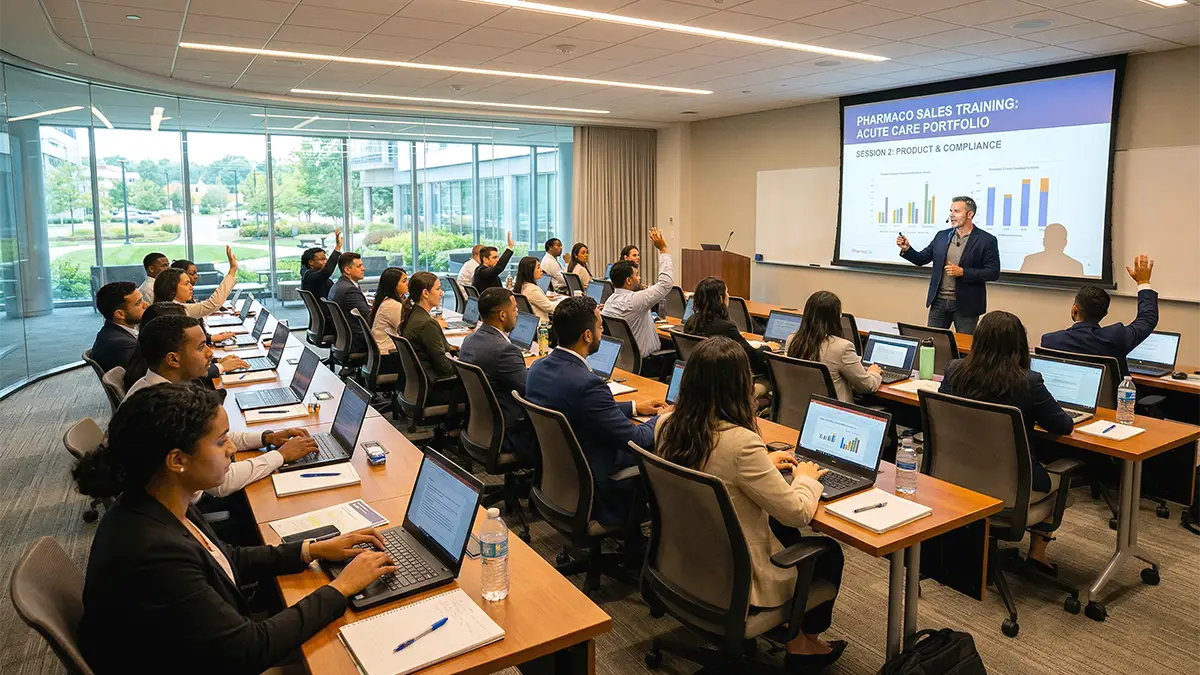
You teach these through roleplays and simulations focused specifically on TA-specific conversations. You're not teaching them oncology disease state again. You're teaching them how to sell oncology differently.
Your sleep competitive positioning doesn't apply in oncology. You need to rebuild this from scratch. Who are your competitors? What are the value propositions? What differentiation matters in oncology?
This requires simulations where reps practice positioning against the actual oncology competitive set, not sleep competitors.
In sleep, your reps know which physicians prescribe. In oncology, they don't. They need to learn new geography, new physicians, new relationships.
This isn't training. This is field ride-outs with someone who knows the oncology space. But it has to be part of your onboarding timeline.
Your managers managed sleep reps effectively because they understood sleep sales dynamics. Now they're coaching oncology reps and they don't understand the conversation.
Your managers need coaching on oncology selling before they start coaching reps on oncology. Otherwise, they'll coach sleep approaches to oncology problems.
Plan for 8-10 weeks minimum for a meaningful TA expansion:
This is longer than traditional product training. It has to be. You're teaching your reps to sell a completely different way.
Companies that approach TA expansion this way see:
Companies that try to compress TA expansion into standard product training see:
Therapeutic area expansion looks like it's about product knowledge. It's actually about selling approach. You have to rebuild how your reps consult, how they structure calls, how they handle objections, how they position.
Knowledge transfer is the easy part. Approach transfer is hard. But it's what actually matters for field success.