Using AI to Boost Growth and Pharma Field Force Productivity
Download Now



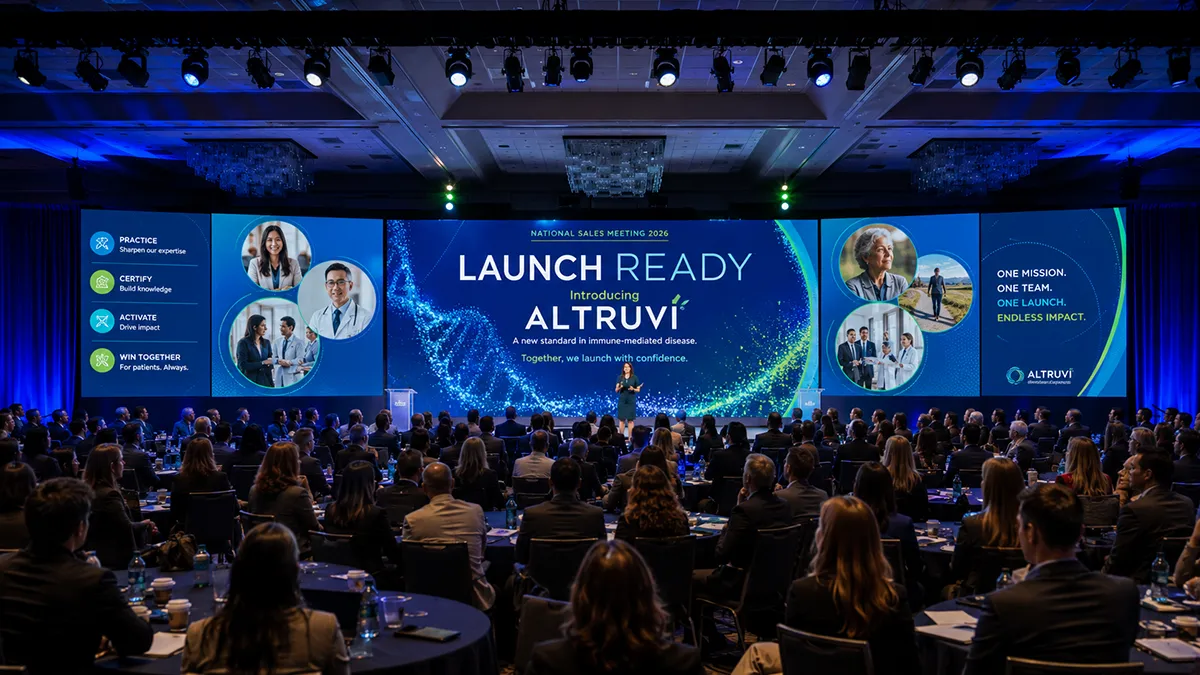

Most sales kickoffs are judged on the wrong day.
The keynote lands. Product launches go well. The team leaves the venue energized. Leadership feels good about the investment. By any measure available at 5pm Friday, the SKO worked.
The honest measure is harder to see. Thirty days later, are reps using the new messaging in live conversations? At sixty days, are managers coaching to the same standard, or have they drifted back to old habits? At ninety days, is the pipeline data showing wins on the plays the meeting emphasized, or is the program already invisible?
A sales kickoff is not the event. It is the launch of a 90-day behavior-change system. This guide walks through how to design and run a kickoff that gets judged on day ninety, not at the closing dinner. In pharma and life sciences, where the same annual event is called the national sales meeting, or NSM, the stakes are higher and the timeline is tighter. Everything here applies to both, and the pharma-specific differences are called out as they come up.
A sales kickoff (SKO) and a national sales meeting (NSM) are the same event with different vocabulary and different constraints. An SKO is the general B2B term: the annual meeting that opens a fiscal year and resets the revenue team on strategy, product, and quota. An NSM is what pharma and life sciences commercial organizations call theirs. It brings the full field force together around brand strategy, new indications, and the coming year of HCP engagement.
The planning discipline is identical. The constraints are not.
Read "sales kickoff" and "NSM" as interchangeable throughout this guide. Where a step changes for regulated teams, it says so.
The classic failure pattern is consistent. Leadership delivers a powerful keynote. Product launches dominate the middle of the agenda. The team leaves the venue energized. Within four to six weeks the new messaging has faded. Pipeline reports do not move. Win rates on emphasized plays do not climb. Managers go back to coaching the way they did before.
Three structural issues cause most of this.
The event is treated as the finish line. When the sales kickoff is positioned as the destination, every dollar and hour goes into the production. Nothing remains for the reinforcement that actually changes how reps sell.
Managers are excluded from the design. First-line sales managers are the single highest-leverage variable in whether new behaviors stick, a point reinforced by research from the Sales Management Association. Yet most kickoffs treat managers as attendees rather than co-owners. The result is a team that learns new skills in the morning and gets coached on the old ones by the afternoon.
No measurement framework. If you cannot answer what specifically you want each rep to do differently 90 days from now, your SKO has no target. Satisfaction surveys are not measurement. Pipeline movement is.
These failures are not new. The reason most teams still fall into them is that the conventional playbook (themes, agenda blocks, keynotes, awards) does not include the post-event scaffolding that makes the event matter. For an NSM, the cost of that gap is steeper: message drift in a regulated field force is a compliance exposure, not just a productivity problem.
The strongest indicator that a sales kickoff worked is what reps do differently in the 90 days that follow. Design the program backward from three milestones, then build everything else to serve them.
Every rep has practiced the top one to three plays trained at the event, been scored against a rubric, and earned certification. Every rep has applied the new messaging to at least one live opportunity with manager feedback. For regulated industries, every rep has demonstrated approved-message delivery with compliance scoring before any HCP or client conversation.
Managers are coaching to behaviors they observe in real calls, simulations, or recordings, not to whatever felt urgent that week. Message adherence is tracked in the data and reviewed weekly. Drift is caught and corrected with targeted coaching, not generic reminders. The content is showing up in pipeline conversations, not gathering dust in an LMS.
Leadership can answer the question that matters most. Did the meeting move the metrics it was designed to move? Pipeline coverage on the emphasized motion. Win rate on the new plays. Ramp time on new hires who joined around the event. For pharma teams, message pull-through in the field and certification coverage across every therapeutic area. If the program worked, the numbers will say so. If it did not, the data will tell you where to course-correct for next year.
This 30-60-90 view is the operating system the rest of this guide builds toward. Every planning decision, every agenda block, and every dollar of budget should be traceable to one of these milestones.
Before any agenda gets drafted, six strategic choices determine whether the sales kickoff will pay off. Get these right and the agenda design is mostly execution. Get them wrong and no amount of polish saves the event.
Pick one. Not three. Not "alignment, enablement, and product launch as our three pillars." One.
The most effective kickoffs run a single golden thread through every session: a new market focus, a sales methodology shift, a category-defining product launch, or a measurable behavioral change you want every rep to demonstrate by Q2. For an NSM, the thread is usually the brand story for the year ahead, and every therapeutic area breakout should ladder back to it.
If you cannot describe the theme in one sentence that connects directly to a business outcome, the theme is not sharp enough.
Define the specific behavioral change you want each rep to demonstrate 90 days after the event. Not what they should know. What they should do.
"Run discovery using the new MEDDPICC framework on every Enterprise opportunity over $50K." "Lead every HCP detailing call with the new safety profile messaging." Concrete, observable, measurable.
This sentence becomes the design brief for the entire agenda. Anything that does not contribute to that change gets cut or moved to async pre-work.
Hold the sales kickoff two to four weeks after the fiscal year closes. This gives finance and revops time to consolidate the prior year metrics so leadership can speak from real data, and gives reps a clean week or two to wind down legacy quotas before the new plays kick in.
For pharma and life sciences teams, the NSM answers to the brand and launch calendar rather than the fiscal one. Work backward from the dates that are not negotiable: anticipated approval or indication expansion, the MLR review window for every message the field will carry, and the first cycle of POA meetings that has to reinforce it. The two-to-four-week window on either side of a launch is when message pull-through is most fragile and reinforcement is most valuable.
In-person, hybrid, or virtual is not a preference question. It is a design question driven by what you need the team to walk away with.
In-person is the right call when the strategic theme requires significant culture or trust building, when peer learning is central to the program, or when product launches require hands-on practice. Plan for two to three days, with no more than six to eight hours of programmed content per day. Most NSMs stay in person for exactly this reason, since certifying a field force and building manager confidence both benefit from the room.
Hybrid works when the core team is dispersed but key segments need in-person time. The risk is unequal experience. If half the team is remote, design for the remote experience first and treat in-person as a layer on top.
Virtual is appropriate for shorter, more targeted programs (one to two days), product launch reinforcement, or when budget realities preclude in-person. Compress the program. Twelve sessions in two days, not thirty.
This is where most teams get it backwards. The conventional split puts 85% to 95% of the budget into the event and 5% to 15% into reinforcement. The high-performing split inverts that: 50% to 60% into the event, 40% to 50% into the 90 days that follow.
Reinforcement spending pays for manager coaching enablement, simulation and practice platforms, content library investment, and the measurement infrastructure to track whether any of it is sticking. For life sciences teams especially, the cost of skipping reinforcement is not just a missed metric. It is reps walking into HCP conversations without enough practice to deliver approved messaging accurately, on the most expensive week of the commercial calendar.
Decide before the event what you will measure at 30, 60, and 90 days. Three categories matter.
Build the dashboard before the event. Populate it the week after. Share it with leadership monthly. The act of measuring makes the program matter for the rest of the year.
The strongest sales kickoffs are planned 16 to 20 weeks out. For a February event, that means starting in September or October. Pharma teams should treat 20 weeks as the floor rather than the ceiling, because MLR review sits inside the timeline and rarely compresses on request.
Weeks 16 to 20 out: Strategy and theme. Lock the strategic theme, the 90-day behavioral target, and the audience. Get leadership alignment on what the event is for. Confirm budget and the event-versus-reinforcement split. For an NSM, submit the first wave of content to MLR now.
Weeks 12 to 16 out: Venue, dates, and design intent. Book the venue and confirm dates with leadership. Draft the design intent document: a one-page summary of theme, audience, behavioral target, format, and measurement framework. Every subsequent decision gets weighed against this document.
Weeks 8 to 12 out: Content design and presenter alignment. Draft the agenda. Identify every presenter and brief them on the design intent. The non-negotiable: every presenter starts their first slide with a one-sentence statement of how their session ties to the strategic theme. Without that, the session does not run.
Weeks 4 to 8 out: Logistics, dry runs, and content finalization. Run two dry runs of the keynote and the major sessions, ideally one with the design team and one with a small group of first-line managers as audience. Cut anything that does not survive both. Finalize the certification or practice plan reps will run during and after the event. For regulated teams, confirm that every scenario reps will practice uses MLR-approved language.
Weeks 0 to 4 out: Final prep, communication cadence, day-of run-of-show. Send the pre-work. Confirm the post-event reinforcement plan is fully built and staffed. Run the final logistics check. The week before the event is for protecting the design, not redesigning it.
A behavior-changing agenda balances three modes: alignment, enablement, and activation.
Alignment. Where are we going and why? This is the executive narrative. Compress it. Most kickoffs over-invest here. One hour of CEO and CRO context at the start of the event is plenty for most teams. The next mention of strategy should be in a working session, not another keynote.
Enablement. How do we get there? This is the methodology, product, and competitive content. The trap here is volume: too many launches, too many frameworks, too many slides. NSM agendas are especially prone to it, because every brand team wants stage time. The discipline: every enablement session ties to a specific skill the rep will be expected to demonstrate, with practice time built into the same session.
Activation. Practice and certification. This is where most programs underinvest, and where decades of research on deliberate practice consistently show the largest skill-transfer gains. Reps should leave the event having actually practiced the new messaging, the new objection handling, and the new closing technique, with feedback from a manager or a coach. Not watching someone else practice. Doing it. The top 10 sales roleplay scenarios guide is a starting library for the practice sessions reps need.
For regulated industries, activation must include compliance verification. Pharma, financial services, and insurance teams need reps to demonstrate accurate delivery of approved messaging before they walk into the field, not just hear it presented. Roleplay scored against your approved criteria, simulation platforms that produce an audit-ready record, or live observation tied to certification programs, all work. Slide decks alone do not. The limitations of slide-only and traditional approaches are covered in Why Traditional Sales Roleplay Falls Short.
The six-to-eight-hour rule applies. After about six hours of structured content per day, retention drops sharply. Anything beyond that ceiling is theater. Move overflow content to pre-work or post-event micro-learning.
The most common NSM design mistake is spending day one getting reps to a baseline they could have reached before they arrived. When several hundred reps land at the venue still trying to recall the brand story, the first day of the most expensive week of the year goes to catch-up instead of skill building.
Pre-work fixes this only if it is practice rather than reading. Send reps into structured, scored practice on the core message in the two to three weeks before the meeting, and the picture changes in two ways. Reps arrive fluent enough to spend live time on the hard parts, objection handling and peer learning. Training leaders arrive with readiness data, so they know which regions and which therapeutic areas need coaching attention on day one instead of discovering it on day three.
This is the model leading pharma teams use to get reps ready for NSMs, and it is the same practice infrastructure the 90-day reinforcement plan runs on. Build it once, use it on both sides of the meeting.
The 90 days after the sales kickoff is where behavior change happens or fails. The playbook below is a starting framework. Adapt the specifics to your team, but do not skip any of the phases.
The week after the event is the highest-leverage moment in the entire program. Reps return with new messaging, new plays, and high motivation. If they do not get reps in within seven days, the new content fades fast.
Run the first round of certifications in week one. For most teams, this means structured practice on the top one to three plays trained at the event, scored against a rubric. AI-powered on-demand practice platforms are particularly effective here because they let every rep practice as many times as they need, with consistent scoring, without burning manager time.
This is exactly how Bayer prepared more than 500 reps for the Bailentra launch: 4,500+ AI-driven practice sessions, a 97% mastery rate, and thousands of trainer hours saved. Every rep walked into HCP conversations certified on approved messaging.
Schedule manager check-ins in weeks two and three. Each manager runs a 30-minute one-on-one with each direct report focused specifically on application of the new content to a live deal or a live territory plan.
By the end of week four, every rep should have demonstrated competency on the core plays, applied them in the field, and received feedback from their manager.
This is when most teams lose the program. The energy has faded. Quarterly business reviews and the first POA meeting are competing for manager attention. The natural pull is back to old habits.
Run weekly micro-learning at this stage. Five to ten minutes of practice on a specific skill, delivered through whatever channel your team uses. The behavioral science behind this is robust: spaced practice produces significantly better retention than massed practice, and is what separates skills that stick from skills that fade. Pair micro-learning with manager observation: each week, the manager listens to one call or watches one simulation and provides feedback.
Track message adherence in the data. Are reps still leading discovery with the new questions? Are HCP detailing calls still using the new safety profile language? When adherence drops, intervene with targeted coaching, not another email.
By day 60, the pipeline should be telling a story. Are deals using the new methodology closing at higher rates? Are pharma reps with higher certification scores driving stronger HCP engagement? Are new hires ramping faster because they were trained on the new plays from day one?
Novartis answered that last question with hard numbers when they replaced manual onboarding checkpoints with AI simulations: a 59% score improvement and a 95% first-attempt pass rate across 150+ specialists, with onboarding compressed from five weeks to just over two. Practice intensity drives both speed and quality.
Pull the data. Compare it to baseline. Share it with leadership. If the program worked, the numbers will say so. If it did not, the numbers will tell you where to course-correct.
The most disciplined teams run a formal 90-day review with leadership. What changed? What stuck? What did not? What carries into the next quarter coaching focus, or the next POA meeting? This review is also the input to next year's design.
AI is no longer a keynote topic. In 2026, every serious SKO and NSM includes AI as an operational agenda item and as the reinforcement engine that makes the program scale.
As an agenda topic. Reps need clear guidance on which AI tools they should be using daily, how to prompt them effectively, and how AI-assisted work fits into certified plays. The teams getting this right are not running "AI in sales" panels. They are running working sessions where reps build AI-assisted workflows for their actual accounts and territories.
As a reinforcement engine. This is the more durable shift. AI sales coaching lets every rep practice the new messaging as many times as they need, scored against your own approved criteria, with instant feedback. For a field force of 200 reps, the difference between every rep getting two coaching reps in the 30 days after the meeting and every rep getting twenty is the difference between a launch that sticks and a launch that fades.
For pharma and other regulated industries, AI practice adds verification at scale. Platforms built for these environments score every session against your MLR-approved criteria and produce an audit-ready record that reps were certified on the messaging before going live. That is the kind of evidence traditional roleplay cannot produce, and it is exactly the gap AI roleplay closes after an NSM.
The teams making AI work in their kickoff are not adding AI sessions on top of the existing program. They are using AI to extend the reach of the program from one event into ongoing practice.
The measurement framework set in Decision 6 above turns into operational dashboards in the 90 days after the event. Three layers.
For regulated industries, add a fourth layer: compliance verification. Did every rep demonstrate approved messaging delivery? Did the post-NSM practice data show consistent adherence across geographies and therapeutic areas? This is what separates a compliance-checkbox meeting from one that meaningfully reduces risk.
A short list of the patterns that cost teams the most.
NSM stands for national sales meeting. It is the annual event where a pharmaceutical or life sciences company brings its full field force together to align on brand strategy, new indications, and the messaging reps will carry into HCP conversations for the coming year. It is the pharma equivalent of a sales kickoff, with two differences that matter: the content is governed by MLR review, and reps frequently have to leave certified on approved messaging rather than merely briefed on it.
They are the same category of event with different vocabulary and different constraints. An SKO usually follows the fiscal calendar and serves a general B2B revenue team. An NSM follows the brand and launch calendar, carries MLR-reviewed content, typically ends in certification, and covers a field force split across therapeutic areas and geographies. Between NSMs, most pharma teams run POA (plan of action) meetings on a quarterly or cycle basis to maintain the message.
Two to three days is the right range for most enterprise teams. Anything shorter than two days struggles to balance alignment, enablement, and activation. Anything longer than three days hits diminishing returns on retention. For virtual or hybrid programs, one to two days is appropriate, but plan for higher reinforcement intensity in the weeks after.
Replace reading-based pre-work with scored practice. In the two to three weeks before the meeting, have every rep run structured practice on the core brand message and the objections they will face, scored against your approved criteria. Reps arrive fluent instead of arriving to catch up, and training leaders arrive with readiness data showing which regions and therapeutic areas need coaching attention on day one.
Two to four weeks after the fiscal year closes for most teams. This gives finance time to consolidate prior-year data and reps a clean transition into the new plan. For pharma and life sciences teams, anchor the NSM to the brand and launch calendar instead, and work backward from the MLR review window rather than forward from a preferred date.
Three additions to the standard playbook. First, build compliance verification into activation: reps need to demonstrate approved-message delivery, not just hear it presented. Second, integrate MLR-approved content directly into practice scenarios so reps are not learning one version in training and another in the field. Third, plan for higher-frequency post-event reinforcement than non-regulated teams need, because the cost of message drift is higher.
The high-performing pattern allocates 50% to 60% of the budget to the event itself and 40% to 50% to the 90-day reinforcement program. Reinforcement spending covers manager coaching enablement, simulation and practice platforms, content library investment, and the measurement infrastructure. Teams that put 90% of the budget into the event almost always underperform.
Bring three to five first-line managers into the design from the start. Give them ownership of specific sessions or specific reinforcement tracks. Train them on the new content before the event so they can coach to it from day one. Managers who help design the program will defend it. Managers who only attend it will revert to old habits.
A great sales kickoff is a launch, not an event. The same is true of a national sales meeting, where the field force leaves with a message the whole year depends on. The teams that treat it that way are the ones that move the metrics that matter at day 30, day 60, and day 90.
Quantified helps life sciences and enterprise teams operationalize the reinforcement playbook above with AI sales coaching that lets every rep practice the new messaging, certify on the new plays, and stay on-message in the 90 days that count most. For teams planning a kickoff or an NSM this year, the Sales Meetings and Kickoffs use case covers exactly how the platform plugs into the planning and reinforcement workflow.
Want to see what readiness looks like before your NSM, and what behavior-change measurement looks like after it? Request a demo.