AI Sales Training: The Buyer's Diagnostic Guide
Download Now



This post is a part of the AI Corner series: a weekly read on the AI news that matters for regulated commercial teams, and what to do about it.
The FDA's new discussion paper on generative AI-enabled medical devices raises the questions commercial leaders should be asking about their own AI deployments: how will we evaluate performance, manage risk, and monitor what changes after launch? Teams with answers to those questions are the ones positioned to put AI to work quickly and aim it where it counts: making the work better and the people doing it more capable.
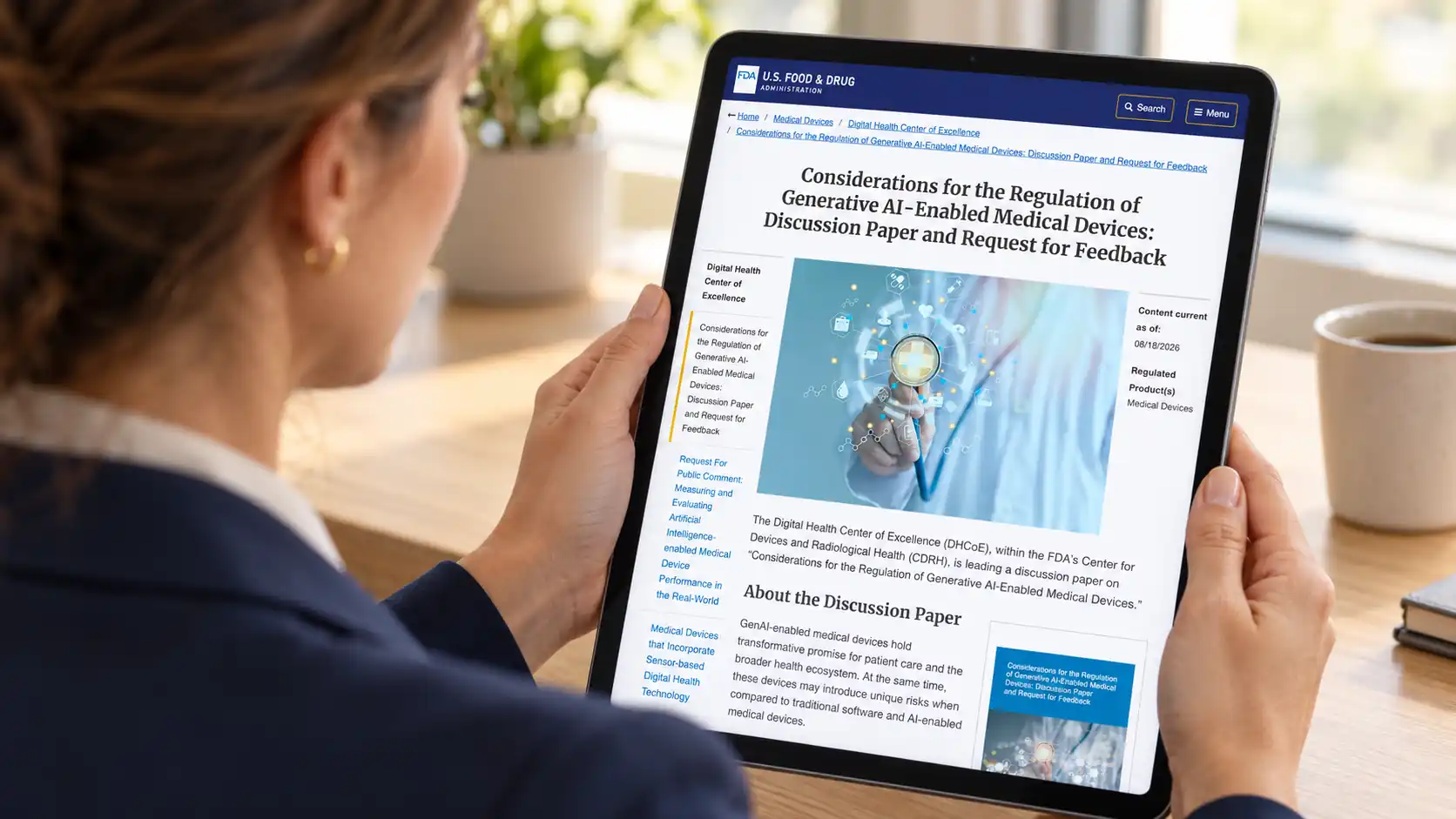
The timely part is the deadline: public comments close October 19 under docket FDA-2026-N-7874. The paper itself, Considerations for the Regulation of Generative AI-Enabled Medical Devices, was released August 18 by the FDA's Digital Health Center of Excellence and is organized around risk assessment, premarket evaluation, postmarket monitoring, and cross-cutting topics that legal analysts note include foundation models and agentic AI systems. The FDA is explicit about what the paper is not: it neither proposes policy changes nor communicates proposed regulatory expectations. It exists to help inform the agency's future regulatory approaches, and formal guidance is expected to follow: the center's director, Rick Abramson, told STAT the week after release that policy guidance on generative AI is on the way.
To be precise about scope: the paper concerns medical devices, and nothing in it regulates the AI tools a commercial organization uses for training, content, or field support. What makes it worth your time is the shape of the questions. Strip away the device specifics and the FDA is asking what any serious deployment of generative AI has to answer. How do you assess risk when outputs are open-ended rather than fixed? How do you evaluate a system before it goes live? How do you keep watching it once it is in the field and the model or the world underneath it changes? And what do you need to know about the foundation model a capability is built on?
Commercial teams already practice this discipline in another form: promotional content goes through review, approval, and an audit trail before it reaches an HCP. Answering these four questions applies the same discipline to AI, and clear governance tends to reduce approval friction, because legal, compliance, and IT say yes sooner when the answers already exist.
No. The paper does not cover commercial tools, and a request for public input is not a stop sign; it is the agency working out how generative AI fits into regulated medicine, agentic systems included. The bigger risk for a commercial organization in 2026 is shallow adoption: tools bought without an owner, deployed without a measurement plan, and quietly abandoned, or used in the shadows while the official evaluation drags on. Governance is the cost of adopting at winning speed, not the alternative to it.
Four questions adapted from the FDA's discussion, plus the work that makes them stick:
To make that concrete with one category: for an AI coaching tool, those questions mean checking that its feedback aligns with your approved messaging, comparing its assessments against your expert coaches' judgments, and watching quality after model updates. Then measure what matters: whether reps improve, not just whether they log more practice sessions.
A deployment that clears governance and then performs starts creating capacity: hours not spent drafting, summarizing, assembling, chasing. The organizations that get the most from AI treat that capacity as a budget and spend a deliberate share of it on their people: more practice, more coaching conversations, more feedback, better preparation for the discussions that carry the quarter. AI used twice, once to do the work and once to build the people, compounds.
The teams that get the most from this era are building more capable AI agents and more capable people at the same time, because as AI takes on the work around the conversation, the conversation itself becomes the differentiator: the ability to listen, adapt, exercise judgment, build trust, and respond in the moment.
Building those more capable people is what AI coaching is for. Quantified is the AI Sales Coaching Platform for life sciences and regulated commercial teams. If you want this post's four questions turned into a working evaluation, the AI Sales Training Buyer's Diagnostic Guide packages them: ten vendor questions, failure-mode tests, and 90-day pilot benchmarks to put in front of your next AI deployment.