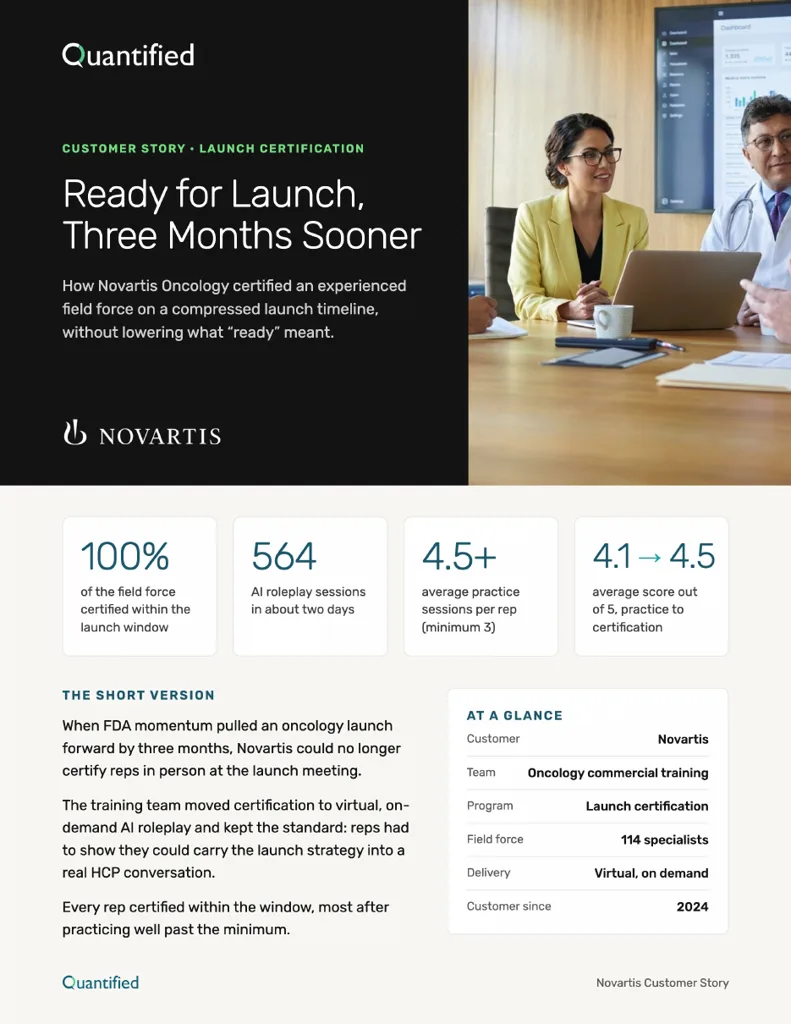
When FDA momentum pulled an oncology launch forward by three months, Novartis could no longer certify reps in person at the launch meeting.
The training team moved certification to virtual, on-demand AI roleplay and kept the standard: reps had to show they could carry the launch strategy into a real HCP conversation.
Every rep certified within the window, most after practicing well past the minimum.
Novartis Oncology was preparing an experienced field force for a new indication in its radioligand therapy portfolio. Strong signals from the FDA pulled the launch training timeline forward by about three months.
The division had always certified reps in person at the launch meeting. Now approval was expected to land before that meeting, and reps could not discuss the new indication until they were certified. The original plan, in-person certification run by trainers and field leaders room by room, became virtual certification in a 24 to 48 hour window.
Running the same certification virtually was possible. The training team saw the risk: it would depend on trainers, field leaders, and cross-functional partners deep in their own launch work.
Moving into an earlier line of therapy changed how reps had to talk with customers. They had to make the case for an unmet need against a strong standard of care, and identify the right patients in a much more varied population.
“Competency alone was not going to be enough to demonstrate readiness.”
Keenan Stare, Product and Disease Training Manager, Novartis
Readiness meant fluency across the disease state, patient journey, product, and marketplace, used in a real HCP conversation. Scoring followed the four sales capabilities Novartis already coaches to, so results fed straight into first-line coaching.
“It wasn’t enough for our team to simply understand or memorize the disease state data and clinical statistics. It was more important for them to transform that into impactful and compelling customer dialogues.”
Novartis already used Quantified for knowledge assessments, and colleagues had piloted AI roleplay. Three things decided it:
Two scenarios covered the conversations that mattered most for the launch strategy:
The AI customer got beliefs and biases, not a script. Approved materials shaped each scenario, and off-label questions were flagged for referral. Pointed only to NCCN and AUA guidelines, it used them to defend its current practice.
“When I first tested the model, I expected it to feel easier than role-playing with a peer. But it really wasn’t.”
Senior leaders reinforced the expectation at every touchpoint, so it was an organizational standard and not only a training request.
“We’ve been in situations in the past where we’re depending on pieces of paper coming from 18 different rooms, from 18 different evaluators, all having to funnel back to one place.”
All 114 specialists certified within the launch window. In about two days they completed 564 AI roleplay sessions, roughly 151 hours of practice. The average rep practiced more than 4.5 times before certifying, against a minimum of three, and some practiced as many as 12 times. The average score rose from 4.1 out of 5 in practice to 4.5 at certification.
Building and testing the scenarios took real effort before approval. After that, certification ran itself: reps practiced and certified on demand, and results arrived in real time.
Off the training team’s plate: lining up trainers, MSLs, and leaders; scheduling sessions and invites; collecting scorecards from every room; compiling scores by hand.
In its place: on-demand certification with no scheduling; the same objective scoring for every rep; real-time results by rep, team, and region; a dashboard flagging who isn’t certified.
“The investment is heavier on the front end, and it’s incredibly light on the back. Overall, I would say it saved me an immense amount of time.”
The division’s training team first used Quantified when the field force doubled and onboarding was cut from five weeks to just over two. More than 150 new specialists and 18 field leaders practiced and completed their verbal assessments with AI roleplay, without pulling existing leaders out of the field. In that program, 95% passed on the first attempt, assessment scores rose 59% on average after practice, and learners averaged 16 practice sessions each.
See how a launch certification scenario is built, practiced, and scored in Quantified’s AI roleplay, using your launch strategy and approved materials. See a launch certification scenario.
The results: