Using AI to Boost Growth and Pharma Field Force Productivity
Download Now



Every pharma sales hiring process has the same gap. It shows up in the same place: after offer acceptance, during the first 90 days, when a new rep who interviewed well turns out not to develop the way you expected.
That gap has a name. It’s coachability.
Resume screens surface product experience, therapeutic area knowledge, and sales tenure. Phone screens reveal communication style and baseline domain fluency. Competency interviews test how candidates frame past situations.
None of these evaluate how a candidate responds when feedback conflicts with their current approach. None of them reveal whether someone incorporates critique or deflects it. None show how quickly a candidate improves when given a structured learning environment.
Coachability is the most predictive long-term performance variable in pharma sales. It is also the least visible in a traditional hiring process.
"Facts and data can be taught. Skillset and learning mindset are harder to assess.”
That is not an opinion. It’s a structural limitation of interview formats that reward preparation over responsiveness.
Here is what actually happens in most pharma sales interviews. A candidate prepares specific answers to anticipated questions. They practice their STAR stories. They research the product portfolio. They come in polished.
The hiring manager sees a confident, knowledgeable candidate. What they cannot see:
A prepared performance is a signal. It is just not the signal that predicts on-the-job development.
AI-powered sales simulation introduces a structured scenario into the hiring process that evaluates candidate behavior, not candidate preparation.
The approach works as follows. After the recruiter screen, candidates receive a 72-hour window to practice a defined pharma sales scenario using an AI roleplay platform. There is no limit to attempts. After each session, the AI provides specific performance feedback. Candidates can incorporate that feedback and try again immediately.
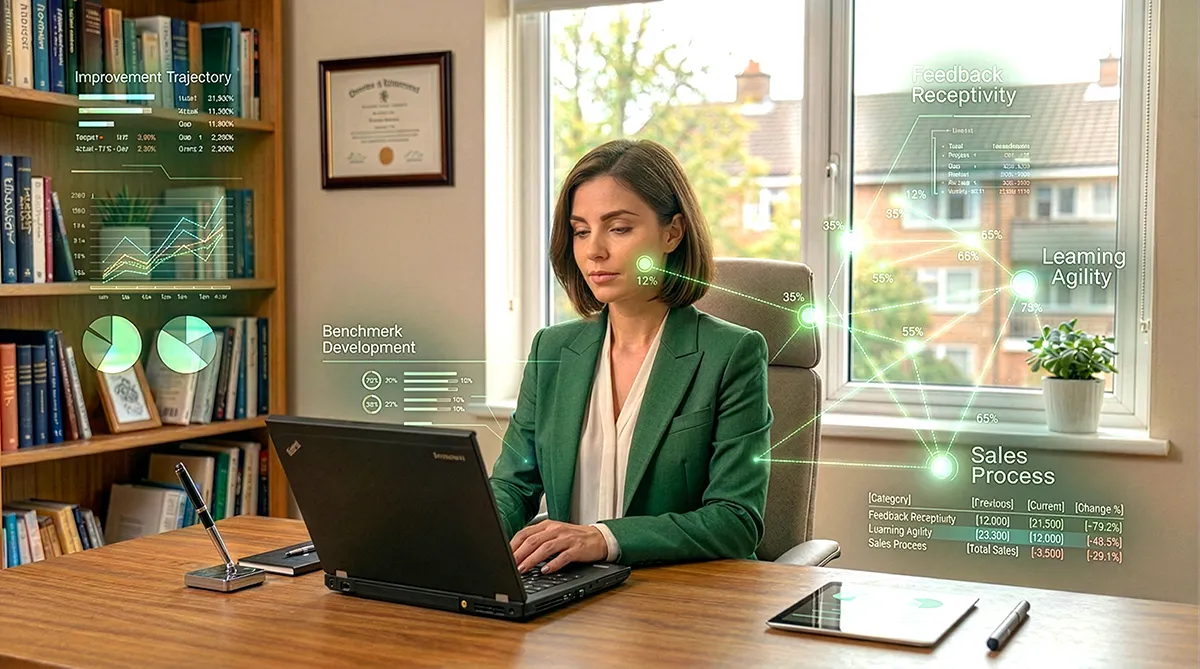
The simulation captures three signals that standard interviews miss:
Before the hiring manager interview, all three signals are delivered as a structured data package. The HM enters the conversation informed, not just prepared.
The most common complaint from pharma sales hiring managers is that they make high-stakes decisions based on 45 minutes of filtered performance. Two candidates can interview identically and have completely different development trajectories.
When simulation data is available before the interview, several things shift:
That is a different quality of interview. It is also a more defensible hiring decision.
One concern that comes up when talent acquisition teams consider adding a simulation step is candidate drop-off. Will candidates complete it? Will it feel like an additional burden?
The data suggests the opposite. When positioned as a preparation tool rather than a screening gate, candidate participation rates are meaningful. Hiring teams typically see 75% of candidates completing the simulation within the 72-hour window.
The framing matters. Candidates who understand the simulation as an opportunity to prepare for the hiring manager interview tend to engage. Those with high learning orientation engage more. Which is precisely the cohort you want to identify.
A common misconception is that adding an AI simulation step requires a significant process overhaul. It does not.
Quantified is designed to sit between the recruiter screen and the hiring manager interview as a discrete, self-contained step. No changes are required to your ATS, offer process, or interview panel structure. The scenario is configured once and deployed consistently across the candidate pool for that role.
Once live, the recruiting team controls when simulation invitations go out. Candidate data is compiled automatically. Hiring managers receive the report before their scheduled interview.
The Question Worth Asking
If your current process consistently produces hires who perform well in interviews and develop slower than expected post-hire, the problem is not your interviewers. The problem is what the interview format is designed to reveal.
AI simulation does not replace the hiring manager interview. It gives that conversation a better foundation.
Quantified's AI Roleplay adds a step between the recruiter screen and the hiring manager interview. Candidates complete a short behavioral exercise, and hiring managers receive data on how each candidate responds to coaching, adapts their approach, and improves across attempts – before the interview even starts. Learn more about how leading pharmaceutical talent acquisition teams are incorporating AI Roleplay into their hiring process.
Are you in Talent Acquisition and curious about how AI can help you deliver better hiring outcomes?
Request your online demo here and we'll be in touch shortly.
A pharma sales hiring assessment is any structured evaluation used to measure candidate capability and potential for a pharmaceutical sales role beyond the standard interview. These can include roleplay exercises, product knowledge tests, or AI-powered simulation scenarios. AI simulation assessments evaluate coachability and learning speed by asking candidates to practice a real sales scenario and tracking performance across multiple attempts.
Coachability is most reliably measured through behavioral observation over time, not a single data point. AI sales simulation provides this by giving candidates multiple practice attempts with specific feedback and tracking whether and how quickly their performance improves. Practice frequency and improvement trajectory together form a coachability signal that interviews alone cannot produce.
Yes. AI sales simulation is particularly well-suited to pharma sales hiring because the role requires a specific combination of product knowledge, conversational fluency, and adaptability in HCP interactions. A simulation scenario can be built around the specific dynamics of a pharma rep conversation, producing directly relevant performance data. The technology also standardizes the evaluation across all candidates in a way that panel interviews cannot.
Not meaningfully, when framed correctly. Hiring teams typically see 75% of candidates completing the simulation when positioned as a preparation tool rather than a screening requirement. Candidates who do not engage are providing information through that choice. Drop-off attributable to simulation friction is minimal compared to drop-off at other hiring stages.